
Nernst Equation
Nernst Equation– The electromotive force (emf) of an electrochemical or galvanic cell, at a given concentration of the electrolytic solution used therein, is determined using the Nernst equation.

The Nernst equation is represented as follows.
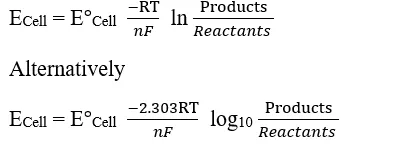
Where R = 8.314 JK-1mole-1 (Gas Constant)
T = 298K (Temperature)
F = 96487 Cmole-1/96500 C (Faraday Constant)
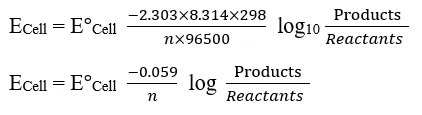
Substituting the above values into the equation.
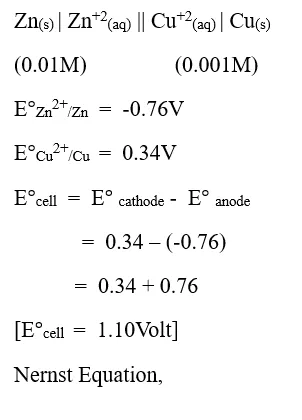
Que. Provide the Nernst equation for the following cell.
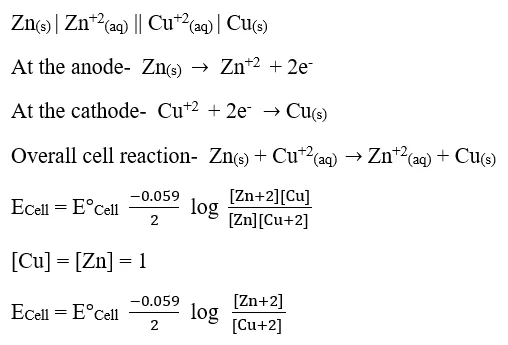
Que. Determine the cell potential for the following cell at a temperature of 298 K, and calculate Ecell by substituting the values into the Nernst equation?
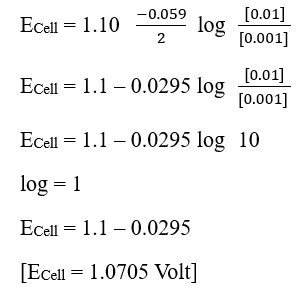
Equilibrium constant from the Nernst equation (Kc)
We consider a general equation as follows.

For example, in the following chemical reaction, the concentration of Zn²⁺ ions increases over time, while the concentration of Cu²⁺ ions decreases. At a certain point, the concentrations of Zn²⁺ and Cu²⁺ ions become constant. This state is known as equilibrium.
At equilibrium, the cell potential becomes zero.
Ecell = 0
T = 298K
For the Daniell cell,
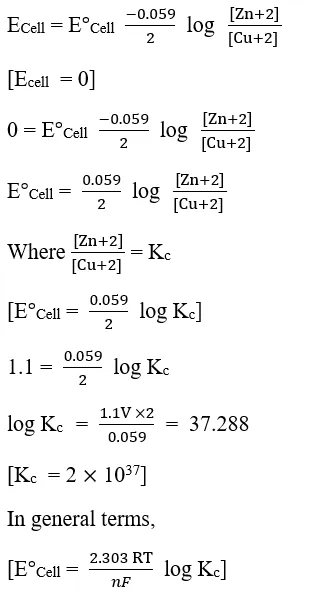
The above equation depicts the relationship between the standard potential of a cell and the equilibrium constant.
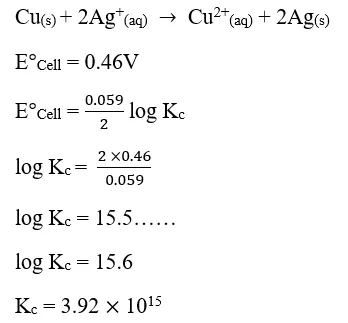
Que. Calculate the equilibrium constant for the following reaction?
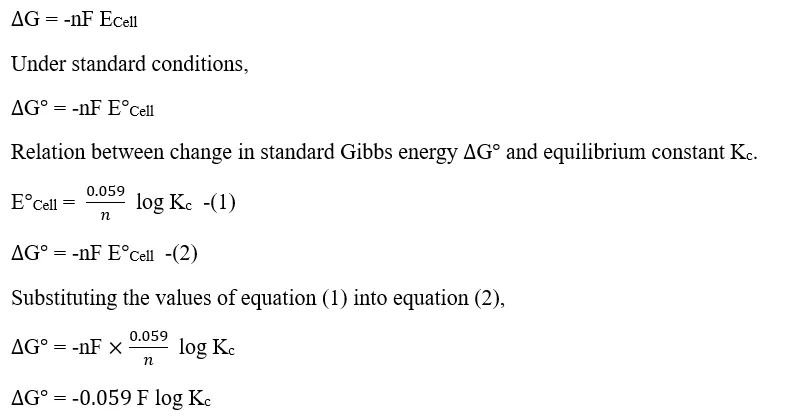
Relation between change in Gibbs free energy and cell potential.
The useful work performed by a system is equal to the change in Gibbs free energy. In a galvanic cell, the change in Gibbs energy is equal to the electrical work [W(elec)] performed by the cell.
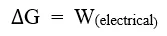
A spontaneous redox reaction takes place within a galvanic cell. Therefore, the value of Gibbs energy for a galvanic cell is negative.

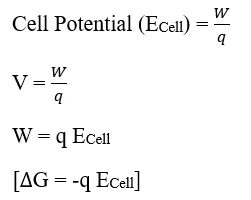
Suppose that n moles of electrons are being transferred within the cell. The total charge transferred in the cell will be equal to nF coulombs.
The values of log.
log10 10 = 1
log10 2 = .3010
log10 3 = .4771
log10 5 = 0.6990
log10 8 = log (23) = 3 log2 = 0.9030