
Human Reproduction.
- Humans undergo sexual reproduction.
- This involves two parents: a male and a female.
- Humans are unisexual organisms.
- Humans exhibit sexual dimorphism.
- Humans are viviparous organisms.
- In humans, a male reproductive system is found in males, and a female reproductive system is found in females.
- The fusion of male and female gametes forms a zygote, which, following embryonic development, is born as an infant.
- The reproductive events in humans encompass the formation of gametes (gametogenesis)—specifically, the production of sperm in males and ova in females—the transfer of sperm into the female reproductive tract (insemination), and the fusion of male and female gametes (fertilization), which results in the formation of a zygote. This is followed by the formation and development of the blastocyst and its attachment to the uterine wall (implantation), embryonic development (gestation), and the process of childbirth.
- Reproductive events in humans occur after puberty. Spermatogenesis continues in aging males, whereas oogenesis in females ceases almost entirely after the age of approximately 50 years.
Male Reproductive System.
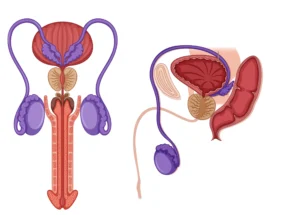
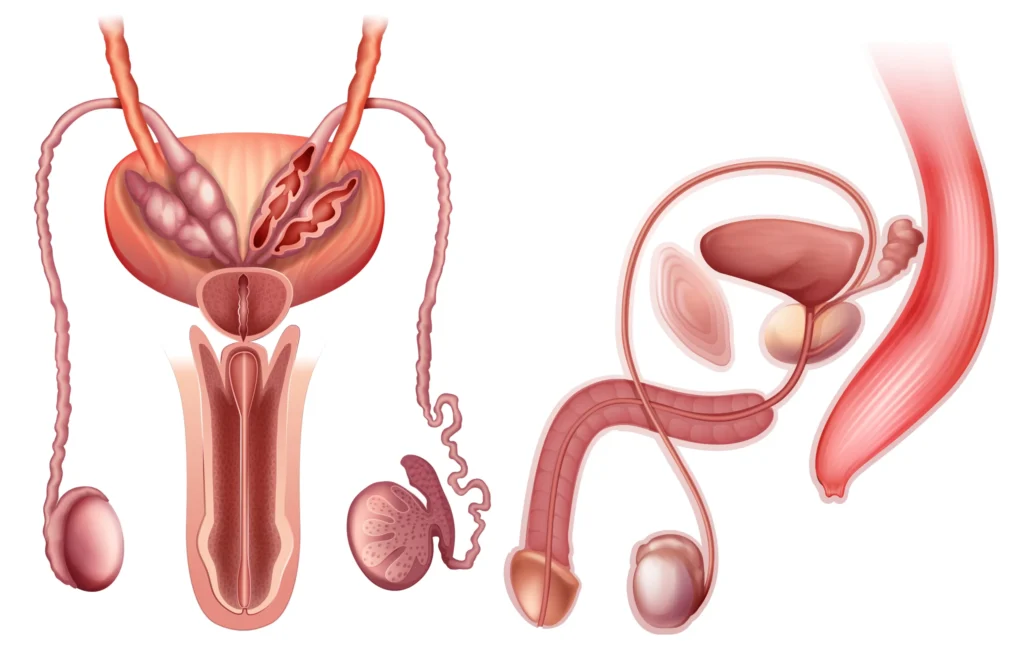
- The male reproductive system is located in the pelvic region of the male body.
- It comprises a pair of testes, accessory ducts, glands, and external genitalia.
- The testes are situated outside the abdominal cavity within a sac-like structure called the scrotum.
- The scrotum helps maintain the temperature of the testes at 2–2.5°C lower than the body temperature; this is essential for spermatogenesis.
- In adults, the testes are oval-shaped, measuring approximately 4–5 cm in length and 2–3 cm in width.
- Each testis contains approximately 250 testicular lobules.
Description.
- Each testicular lobule contains one to three highly coiled seminiferous tubules, within which spermatozoa are produced.
- Two types of cells are found within the seminiferous tubules:
- 1. Male germ cells 2. Sertoli cells
- Male germ cells undergo spermatogenesis through meiosis.
- Sertoli cells provide nourishment to the developing sperm cells.
- The region external to the seminiferous tubules is called the interstitial space; this interstitial space contains small blood vessels as well as interstitial (or Leydig) cells.
- Leydig cells synthesize and secrete androgen hormones.
Ducts.
- The accessory ducts of the male reproductive system include the rete testis, vasa efferentia, epididymis, and vas deferens.
- The seminiferous tubules of the testis open into the vasa efferentia through the rete testis.
Rete Testis – Slender tubules emerge from the seminiferous tubules; inside the testis, these tubules interconnect to form a network known as the Rete Testis.
Epididymis – This is a long and highly coiled tubule, measuring approximately 6 meters in length. A structure formed by this highly coiled tubule is situated along the inner margin of each testis; this structure is called the Epididymis.
Functions of the Epididymis.
- Spermatozoa are stored within the epididymis. It is also the site where they undergo maturation.
- It provides a passageway for sperm to travel from the testes to the vas deferens.
- Spermatozoa can remain stored in the epididymis for up to one month. Following ejaculation, they are expelled from the body through the urethra.
Vas Deferens – The vas deferens is a tubular structure approximately 45 cm in length, characterized by muscular walls. Originating from the posterior aspect of the epididymis, the vas deferens ascends into the abdominal cavity, where it forms a loop over the urinary bladder.
Vas deferens + Seminal vesicle duct = Ejaculatory duct
Ejaculatory Duct — The small duct emerging from the seminal vesicle, together with the vas deferens, forms the ejaculatory duct.
Urethra– The duct emerging from the urinary bladder joins with the ejaculatory duct to form the urinogenital duct. It is a tube approximately 20 cm in length that opens to the outside through the urinogenital aperture located at the tip of the penis. The urethra serves as a common passageway for both urine and semen.
Accessory Glands —
- Seminal Vesicles — 1 pair
- Prostate Gland — 1 pair
- Bulbourethral Glands — 1 pair
1. Seminal Vesicles — The seminal vesicles are sac-like structures, and they occur as a pair. They secrete a yellowish, viscous substance. This secretion contains fructose, which provides energy to the spermatozoa in the form of ATP.
2. Prostate Gland — This gland is situated at the base of the urethra. Each lobe opens into the urethra via a duct. They produce a white, slightly alkaline secretion characterized by a distinct odor.
3. Bulbourethral Glands — These glands occur as a pair and are situated behind the base of the prostate. The secretion of the bulbourethral glands also aids in providing lubrication to the penis during sexual intercourse.
External Genitalia .
Penis– This is the male copulatory organ. It is composed of specialized tissues that facilitate penile erection, thereby making insemination possible. The enlarged distal end of the penis is known as the glans penis; it is covered by a loose fold of skin called the foreskin (prepuce).