
Abnormal Molar Mass and van’t Hoff Factor (i)
Abnormal Molar Mass – If a solute undergoes dissociation or association within a solution, the molar mass of that solute—when determined based on colligative properties—will appear to be either lower or higher than its theoretical (normal) molar mass. This is referred to as abnormal molar mass.
van’t Hoff Factor (i) – To quantify the extent to which a solute undergoes dissociation or association in a solution, van’t Hoff introduced a coefficient known as the van’t Hoff factor.

Que. What will be the value of the van’t Hoff factor for ethanoic acid in benzene?
Ans Two molecules of ethanoic acid bond together via hydrogen bonding in benzene to form a dimer. Consequently, acetic acid undergoes association within the solution, and the formation of dimers results in a reduction in the total number of particles present.
Que. What will be the molar mass of ethanoic acid in benzene?
Ans. (CH₃COOH)₂
[12 + 3(1) + 12 + 16 + 16 + 1]₂
(60)₂ = 60 × 2
120 grams
Que. What is Edema?
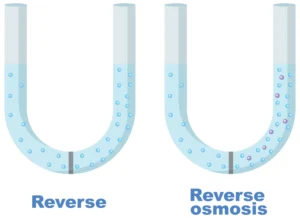
Ans. The osmotic pressure of the fluid contained within blood cells is equivalent to that of a 0.9% (W/V) NaCl solution, making it safe to inject intravenously. If blood cells are placed in a NaCl solution with a concentration greater than 0.9% (W/V), water will flow out of the cells, causing them to shrink. Conversely, when blood cells are placed in a NaCl solution with a concentration lower than 0.9% (W/V), water will flow into the cells due to osmosis, causing them to swell. Consequently, in individuals who consume excessive amounts of salt, water accumulates in the interstitial spaces between their tissue cells. The resulting swelling is known as Edema.
Que. Give an example of an antifreeze substance.
Ans. Ethylene glycol acts as an antifreeze agent.
Que. What is a de-icing agent?
Ans. A substance that lowers the freezing point of water is called a de-icing agent. When applied to ice, it causes the ice to melt.
Examples. NaCl, CaCl₂
De-icing agents are used to remove accumulated ice from roads.
Que. Why is gargling with salt water commonly recommended when one has a swollen throat?
Ans. Salt water is hypertonic. As a result, it draws out the factors causing the swelling or irritation in the throat.
Que. What is the characteristic property of a semi-permeable membrane, and what is the reason behind this property?
Ans. A membrane that allows solvent molecules to pass through it but prevents solute particles from passing is called a semi-permeable membrane (SPM).
Animal membranes (parchment) and plant membranes function as semi-permeable membranes; additionally, a layer made of copper ferrocyanide [Fe(CN)₆] also acts as a semi-permeable membrane.
Reason. Solvent molecules spontaneously flow from a solution of lower concentration to a solution of higher concentration.
Que. Arrange the following aqueous solutions in the increasing order of their van’t Hoff factors:
Urea, MgCl₂, Al₂(SO₄)₃, KCl
Ans. Urea < KCl < MgCl₂ < Al₂(SO₄)₃
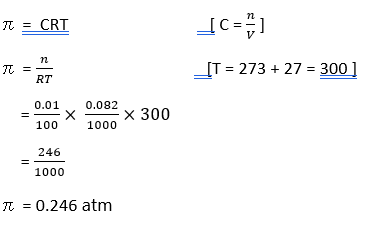
Que. Calculate the osmotic pressure of a 0.01 m solution of urea at a temperature of 27°C.
(R = 0.082 L·atm/K·mol)
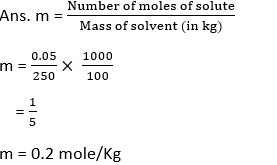
Que. 0.05 moles of ethanoic acid are dissolved in 250 grams of benzene. Calculate the molality of the solution.
Que. What is the unit of the freezing point depression constant (Kf)?
Ans. K·kg·mol⁻¹
K·kg/mol
Que. Write the names of the solute and solvent present in sodium amalgam solution.
Solute = mercury
Solvent = sodium
This is an example of a solid solution, in which the solvent is solid and the solute is liquid.
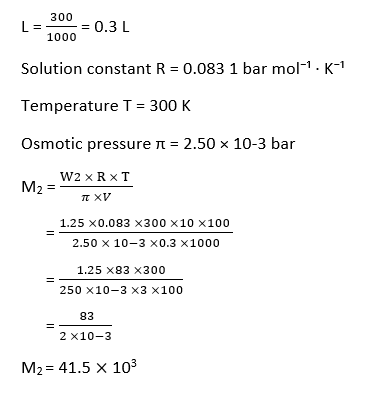
Que. 1.25 gm of protein is present in 300 ml of aqueous solution. The osmotic pressure of this solution at 300 K was found to be 2.50 × 10⁻³ bar. Calculate the molar mass of the protein?
(R = 0.083 1 bar mol⁻¹ · K⁻¹)
Mass of protein (W) = 1.25 gm
Molar mass of protein M = ?
Volume of solution V = 300 ml