
Vapor Pressure of Liquid Solutions.
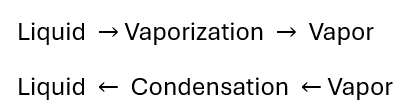
The pressure exerted by a volatile liquid on the surface of the liquid by its vapor at equilibrium is called the vapor pressure exerted by that surface on the liquid.
Liquid-Liquid Solution – The vapor pressure of a solution obtained by mixing a volatile solute (liquid) with a volatile solvent is due to the vapor pressure of both components.
→ Raoult gave a quantitative relationship between the partial pressure of each component and the mole fraction of that component for a volatile solution, which is called Raoult’s Law.
OR
→ When both the solute and solvent are liquids, both evaporate, i.e., vapor is formed; the total vapor pressure of the solution is equal to the sum of the partial vapor pressures of the two liquids.
Raoult’s Law.
According to this law, the vapor pressure of a volatile component in a solution is proportional to its mole fraction.
Let the vapor pressure of volatile component 1 in a solution be P1 and its mole fraction in the solution be X1. Similarly, the partial vapor pressure of component 2 is P2 and its mole fraction in the solution is X2.
According to Raoult’s law,
For component 1,
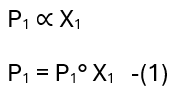
Where P1° = pure vapor pressure of component 1
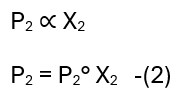
For component 2,
Total vapor pressure of the solution –
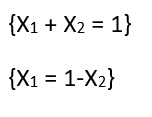

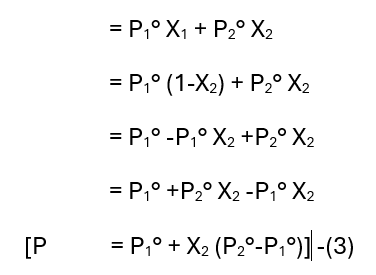
→ Conclusion– The following conclusion can be drawn from Eq. (3).
- The total vapor pressure of a solution is related to the mole fraction of both component 1 and component 2.
- The total vapor pressure of a solution shows a linear relationship with the mole fraction X2 of component 2.
Solid-liquid solutions and vapor pressure.
When a non-volatile solid is dissolved in a liquid solvent, the vapor pressure of the resulting solution is always lower than that of the pure solvent; this is called lowering of vapor pressure.
Reason– In a volatile liquid solvent, particles of both the solute solid and the solvent liquid are present on the surface of the solution, but only the solvent particles are converted to vapor. Consequently, the number of particles evaporating from the surface is less in the solution than in the pure solvent, which is why the vapor pressure of the solution is lower than that of the pure solvent.
Raoult’s Law for Solid-Liquid Solutions.
When a non-volatile solid is dissolved in a solvent, the vapor pressure of the resulting solution is due solely to the vapor pressure of the solvent.
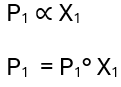
Suppose, in such a solution, the vapor pressure of the solvent is P1, its mole fraction is X1, and the mole fraction of the solute is X2.
According to Raoult’s law,
Raoult’s law, a special case of Henry’s law.
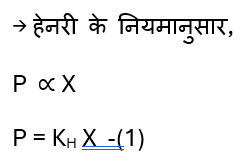
→ According to Henry’s law,
→ According to Raoult’s law,
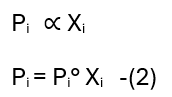
Comparing equations (1) and (2), we find that the only difference between the two equations is the constant.
Henry’s law constant = KH
Raoult’s law constant = Pi°
Therefore, Raoult’s law is a special case of Henry’s law.