
Electrochemistry
Electrochemistry—”The branch of chemistry that deals with the study of the conversion of chemical energy into electrical energy, and electrical energy into chemical energy, is known as Electrochemistry.”
Cell—The device through which the conversion of chemical energy into electrical energy, or electrical energy into chemical energy, takes place is called a cell.
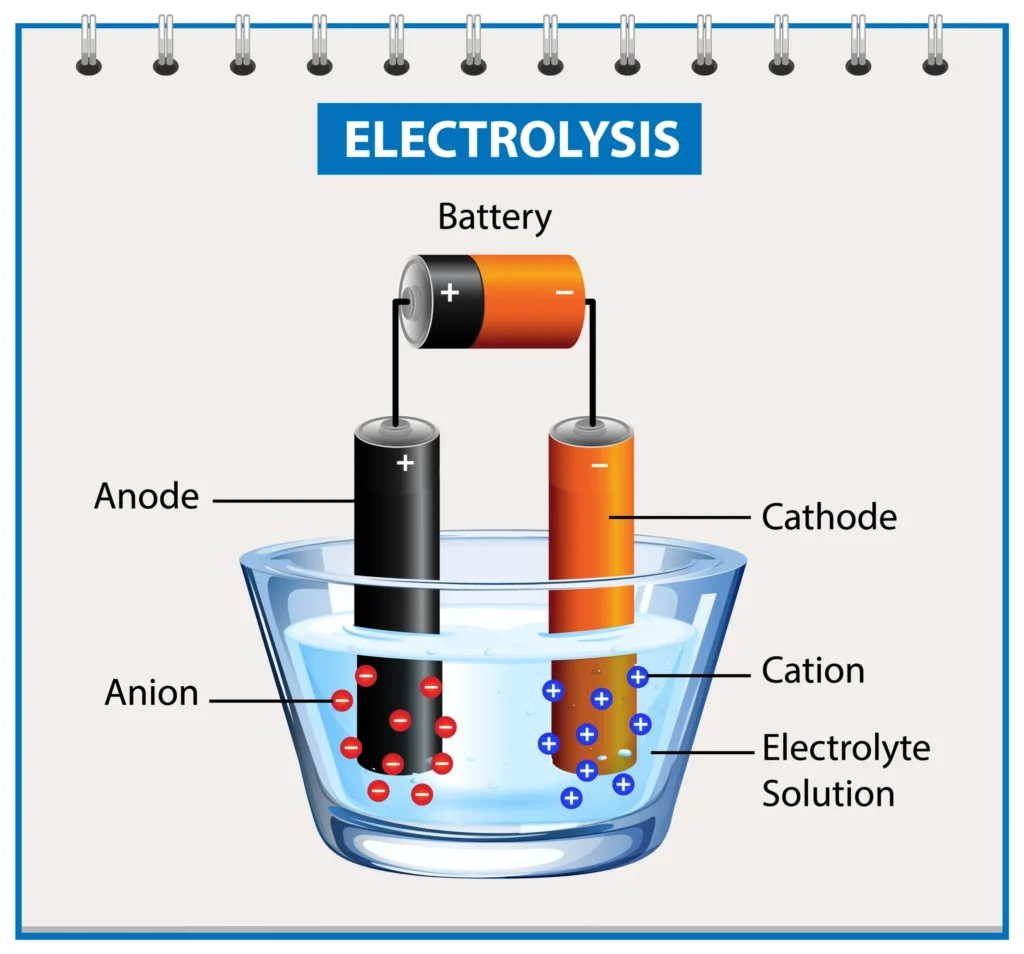
Cells are of two types.
- Electrochemical Cells (Galvanic Cells / Voltaic Cells)
- Electrolytic Cells
Electrochemical Cells / Galvanic Cells / Voltaic Cells
Cells that convert chemical energy into electrical energy are known as Electrochemical Cells / Galvanic Cells / Voltaic Cells. In this type of cell, a spontaneous redox reaction occurs.
Construction—
In a Daniel cell, an aqueous solution of ZnSO₄ is taken in a glass container, and a rod of zinc (Zn) metal is immersed in it; this rod acts as the anode. In a separate container, a CuSO₄ solution is taken, and a copper (Cu) rod is immersed in it; this rod acts as the cathode. Both electrodes are connected by a connecting wire. The two solutions are linked by an inverted ‘U’-shaped glass tube; this tube is filled with a mixture containing KCl or KNO₃ (or NH₄Cl) and agar-agar (a seaweed extract). This tube is known as the Salt Bridge.
Functions of the Salt Bridge.
- It completes the electrical circuit.
- It maintains the electrical neutrality of the electrolyte solutions.
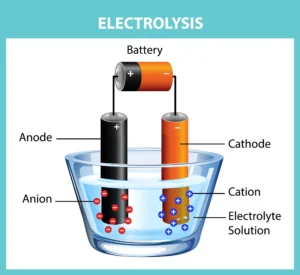
Note—In a galvanic cell, the half-cell where oxidation occurs is called the anode, and its potential is negative relative to the solution. The other half-cell, where reduction occurs, is called the cathode, and its potential is positive relative to the solution. Half-reactions of oxidation and reduction occurring at the electrodes.
At the Anode — Zn(s) — Zn+2(aq) + 2e–
(Oxidation)
At the Cathode — Cu+2(aq) + 2e– — Cu(s)
(Reduction)
Overall Cell Reaction — Zn(s) + Cu+2(aq) — Zn+2(aq) + Cu(s)
Que. Write the half-reaction equations occurring at the anode and cathode in a Daniel cell (Galvanic cell).
At the Anode —Zn(s) — Zn+2(aq) + 2e–
At the Cathode — Cu+2(aq) + 2e– — Cu(s)
→ The standard cell potential of a Daniel cell is [1.1 V].
Cell Representation of a Galvanic Cell —
Zn(s) | Zn+2(aq) || Cu+2(aq) | Cu(s)
Que.Write the chemical equations for the half-reactions occurring at the electrodes for the following cell.
Cr(s) | Cr+3(aq) || Pb+2(aq) | Pb(s)
At the Anode — Cr(s) — Cr+3(aq) + 3e–
At the Cathode- Pb+2(aq) + 2e– — Pb(s)
Electrode Potential (E)
→ When a metal electrode is immersed in an electrolytic solution, two types of processes are possible.
- If the metal electrode has a tendency to gain electrons (e⁻), the electrode acquires a negative charge, while the electrolytic solution acquires a positive charge.
- If the metal electrode has a tendency to lose electrons (e⁻), the electrode acquires a positive charge, while the electrolytic solution acquires a negative charge.
Thus, when a metal electrode is placed in its corresponding electrolytic solution, a separation of charges occurs between the electrode and the solution; this results in the generation of a potential difference between them, which is known as the Electrode Potential.
Standard Electrode Potential (E°) — At a temperature of 298 K and a pressure of 1 atmosphere (atm). The electrode potential of an electrode placed in an electrolytic solution with a molar concentration of 1 M is called the Standard Electrode Potential (E°).
Standard Electrode Potential is represented in two ways.
- Standard Oxidation Potential (E° m / m+)
- Standard Reduction Potential (E° mn+ / m)
Note — According to IUPAC conventions, the standard reduction potential is adopted for any given electrode. The values for the oxidation potential and the reduction potential are numerically equal, but they differ in sign. According to IUPAC, the standard reduction potential is now called the standard electrode potential.