
Electrochemical Series – If various elements are arranged in either increasing or decreasing order of their standard reduction potentials, the resulting series is called the electrochemical series.
Utility of the Electrochemical Series –
- In the electrochemical series, an element with a higher standard reduction potential has a greater tendency to undergo reduction; that is, it acts as an oxidizing agent.
- Elements positioned above Hydrogen (H) in the electrochemical series displace Hydrogen from acids when they react with them, whereas elements positioned below Hydrogen do not react with acids.
- Metals situated higher in the electrochemical series displace ions from the solutions of metals situated lower in the series.
For example, when a Zinc (Zn) rod is placed in a Copper Sulfate (CuSO₄) solution, Zn displaces Cu²⁺ ions from the solution.
Reactivity series of metals based on standard reduction potential –
Li
K
Ba
Ca
Na
Mg
Al Negative reduction potential: Ability to displace H₂ from acids.
Zn
Cr
Fe
Cd
Ni
Sn
Pb
[H2 standard reduction potentials 0.0V]
Cu
I2
Hg
Ag
Br2
O2 Positive reduction potential: Cannot displace H₂ from acids.Cl2
Au
Mn
Pt
F2
increasing order of activity
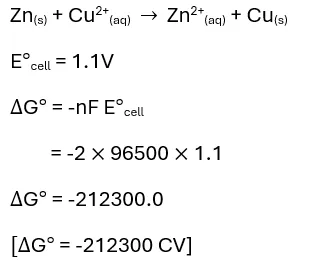
Que. The standard cell potential for a Daniell cell is 1.1 V. Calculate the standard Gibbs energy for the following reaction?
Que. Calculate the EMF of a cell in which the following reaction takes place.
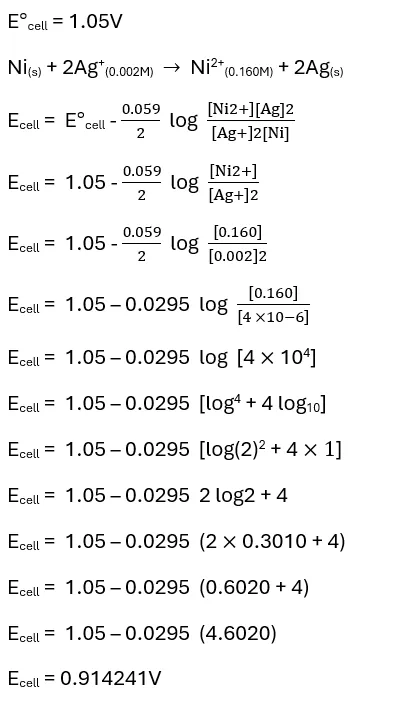
Therefore, the EMF of the cell = 0.9142V
Electrolytic Cell.
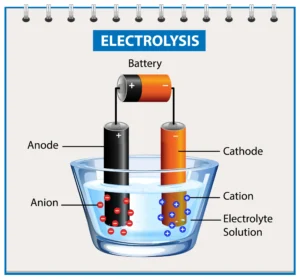
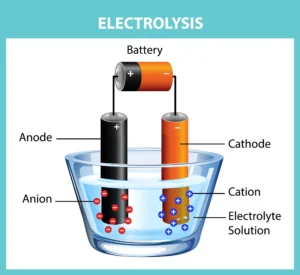
Cells that convert electrical energy into chemical energy are called electrolytic cells.
In this type of cell, an electric current from an external source is passed through the cell, causing a non-spontaneous redox reaction to occur.
Description-
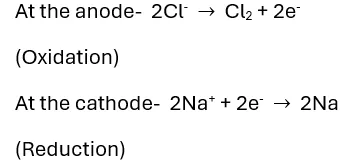
In this type of cell, the electrolyte (NaCl)—either in a molten state or in solution—is placed in a container equipped with two electrodes. The electrode connected to the positive terminal of the battery is called the anode, while the one connected to the negative terminal is called the cathode.
When an electric current is passed through an electrolytic cell, a non-spontaneous redox reaction occurs, resulting in oxidation at the anode and reduction at the cathode.
Products formed from the electrolysis of certain electrolytes.
- Aqueous NaCl solution – H₂ gas is obtained at the cathode, Cl₂ at the anode, and NaOH in the aqueous solution.
- Molten NaCl – Na is obtained at the cathode and Cl₂ at the anode.
- Aqueous CuSO₄ solution – With Pt electrodes, Cu is obtained at the cathode and O₂ gas at the anode.
- With Cu electrodes – Cu is obtained at the cathode, while the anode undergoes dissolution.