
Electrostatics.
Electrostatics – The branch of physics that deals with the study of the properties of stationary charges and the phenomena associated with them is called electrostatics.
Electrodynamics – The branch of physics that deals with the study of the properties of moving charges and the phenomena associated with them is called electrodynamics.
Charge.
In 600 BC, Thales discovered a yellow substance called amber near the Baltic Sea. When this substance was rubbed against wool, it acquired the ability to attract small particles (such as bits of straw).
In 1600 AD, Gilbert found that not only amber but also materials like glass, ebonite, and sulfur acquire the property of attracting small fragments when rubbed against other substances.
Explanation of friction .
When a glass rod is rubbed against silk, some electrons (e⁻) are transferred from the glass rod to the silk resulting in a deficit of electrons on the glass rod and an excess of electrons on the silk cloth.
If an ebonite rod is rubbed against cat fur, electrons transfer from the cat fur to the ebonite rod, resulting in an excess of electrons on the ebonite rod and a deficit of electrons on the cat fur.
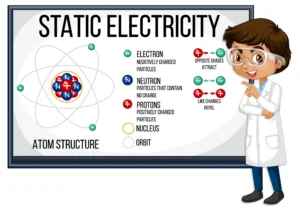
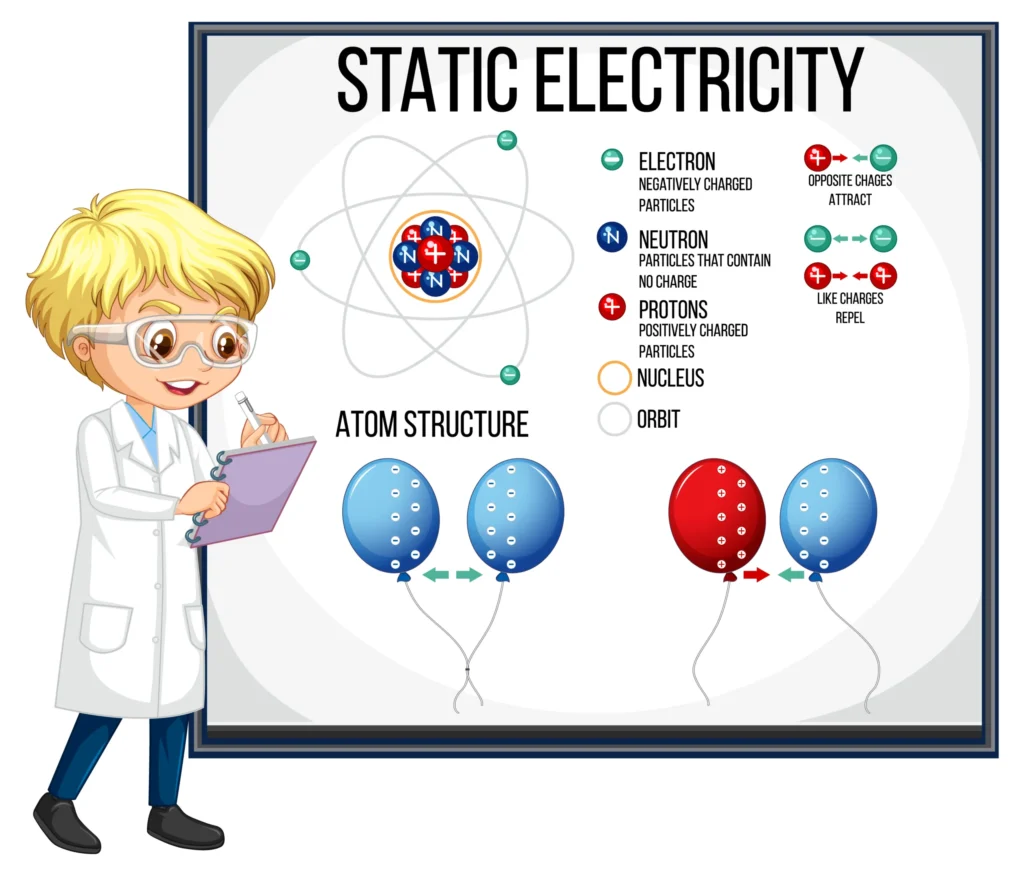
Conclusion – Charges of the same nature repel each other.
– Charges of opposite nature attract each other.
Note. When two materials are rubbed together, electrons transfer from one material to the other.
Fundamental Particle Mass Charge
e⁻ 9.1 × 10⁻³¹ kg – 1.6 × 10⁻¹⁹ C
p⁺ 1.66 × 10⁻²⁷ kg + 1.6 × 10⁻¹⁹ C
n⁰ 1.67 × 10⁻²⁷ kg 0
Conductors – Substances that allow the flow of charges to occur easily are called conductors.
Example – Silver is the best conductor. Conductors contain a very large number of free electrons. The free electrons present in a conductor are free to move.
Insulators – Substances that do not allow the flow of charges to occur easily are called insulators.
Examples – Wood, plastic, glass.
In insulators, electrons are not free to move. The number of free electrons in them is negligible. When a charge is applied to an insulator, it remains localized at the specific point where the charge was applied.
Fundamental properties/laws of charges .
1. Law of Additivity – The total charge of a system is the algebraic sum of all the individual charges present in it.

Question – If the charges present in a system are 4q, -2q, 3q, -4q, and 6q, find the total charge of the system and state its nature.
4q – 2q + 3q – 4q + 6q
13q – 6q
+7q Nature = Positive
2. Law of Conservation of Charge – Charge can neither be created nor destroyed, that is, the total charge within any system remains constant.
3. Law of Quantization of Charge – The charge on an object is an integral multiple of the charge of an electron (e⁻).
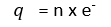
q = Charge on the object
n = Number of charges / Atomic number
Que. 8016 Find the charge on the nucleus?
q = 8 × 1.6 × 10⁻¹⁹
q = 12.8 × 10⁻¹⁹ C
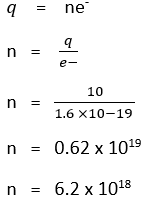
Question. Find the number of electrons (e⁻) in a charge of 1 C ?
Charge .
- Charge is a scalar quantity.
- Charge can be transferred.
- Charge is conserved.
- Charge is invariant.
- Charge is directly related to mass.
- The unit of charge is the Coulomb.
- From the definition of electric current,

= Ampere × Second
q = Coulomb
- The smaller unit of charge is the Franklin.
- The largest unit of charge is the Faraday.
1 F = 96,500 C
1 C = 3 × 10⁻⁹ fr