
Cell Potential or Electromotive Force (EMF) of a Cell.
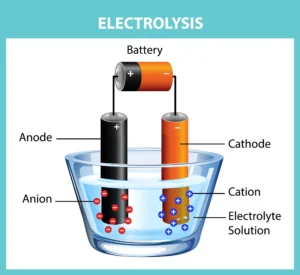
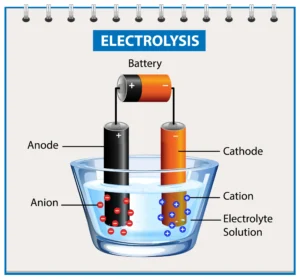
In an electrochemical cell, the potential difference between the cathode and the anode is called the cell potential.
Alternatively,
The potential difference between the two electrodes is termed the cell potential or the cell electromotive force (EMF).
Ecell = Ecathode – Eanode
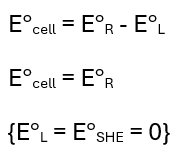
ECell = ER – EL

Standard Cell Potential
Ecell = E
cathode – E
anode
Note. EMF of a Daniell Cell—
Ecell = E
(Cu²⁺/Cu) – E
(Zn²⁺/Zn)
Que. Calculate the cell potential for the following cell at a temperature of 298 K.
Zn(s) | Zn²⁺(aq) || Cu²⁺(aq) | Cu(s)
E°(Zn²⁺/Zn) = -0.76 Volts (Anode)
E°(Cu²⁺/Cu) = +0.34 Volts (Cathode)
Ecell = Ecathode – Eanode
= 0.34 – (-0.76)
= 0.34 + 0.76
= 1.10 Volts
Standard Hydrogen Potential.
The electrode potential of any metal electrode is determined with the aid of the Standard Hydrogen Electrode.
Key points regarding the Standard Hydrogen Electrode (SHE).
- It is a gas-ion electrode.
- It serves as a reference electrode.
- This electrode can be utilized as both an anode and a cathode.
- The oxidation and reduction potentials of the Standard Hydrogen Electrode are 0.0 Volts.
Description of the Standard Hydrogen Electrode.
In the SHE (Standard Hydrogen Electrode) setup, a solution with a concentration of 1M is placed in a container. A glass tube (jacket) is inserted into this container, and a platinum wire is placed inside this jacket to serve as the electrode. A platinum (Pt) foil is attached to the lower end of the wire. Hydrogen gas is passed through the glass tube at a pressure of 1 atm. A certain amount of the H2 gas gets adsorbed onto the surface of the Pt foil, while the remaining H2 gas escapes into the solution in the form of bubbles.
Cell Representation of the Standard Hydrogen Electrode.
As an Anode (Oxidation)-
Pt | H2 (g. 1atm) | H+(aq. 1M)
Oxidation Half-Reaction
H2 → 2H+ + 2e–
As a Cathode (Reduction)-
H+(aq. 1M) | H2 (g. 1atm) | Pt
Reduction Half-Reaction:
2H+ + 2e– → H2
Note. The potential of the SHE is assumed to be zero. Therefore, the standard potential of the cell (Ecell) yields the value of the standard reduction potential of the other half-cell.