
Pair of linear equations in two variables Solutions
1. Solve the following pair of linear equations by the substitution method:
1. x + y = 14 – (1) x – y = 4 – (2)
From equation 1,
X + y = 14
Y = 14 – x – (3)
From equations 2 and 3,
X – ( 14 – x ) = 4
X – 14 + x = 4
2x = 4 + 14
2x = 18

X = 9
Substituting the value of x into equation 3,
Y = 14 – x
Y = 14 – 9
Y = 5

From equation 1,
s – t = 3
s = t + 3 – 3
From equations 2 and 3,
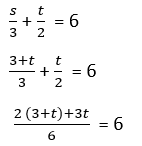
6 + 2t + 3t = 6 X 6
6 + 5t = 36
5t = 36 – 6
5t = 30

t = 6
Substituting the value of t into equation 3,
S = 3 + t
S = 3+6
S = 9
3. 3x – y = 3 – (1) 9x – 3y = 9 – (2)
From equation 1,
3x – y = 3
-y = 3 – 3x
Y = – ( 3 – 3x )
Y = 3x – 3 – (3)
From equations 2 and 3,
9x – 3y = 9
9x – 3 ( 3x – 3 ) = 9
9x – 9x + 9 = 9
0 + 9 = 9
0 = 9 – 9
0 = 0
Here, there are infinitely many solutions for x, and the value of y is 3x – 3.
4. 0.2x + 0.3y = 1.3
0.4x + 0.5y = 2.3
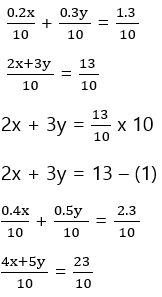
4x + 5y = 23 – (2)
From equation 1,
2x + 3y = 13
2x = 13 – 3y
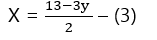
From equations 2 and 3,
4x + 5y = 23
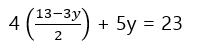
2 ( 13 – 3y ) + 5y = 23
26 – 6y + 5y = 23
-y = 23 – 26
-y = -3
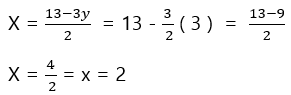
Y = 3
Substituting the value of y into equation 3,
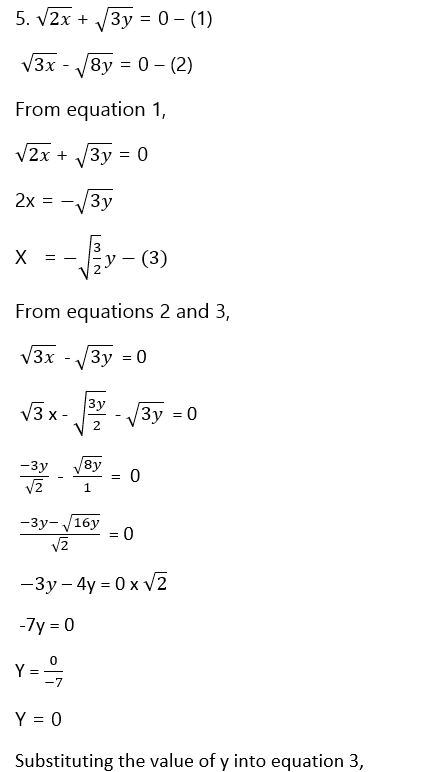
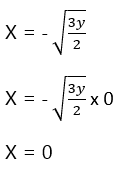
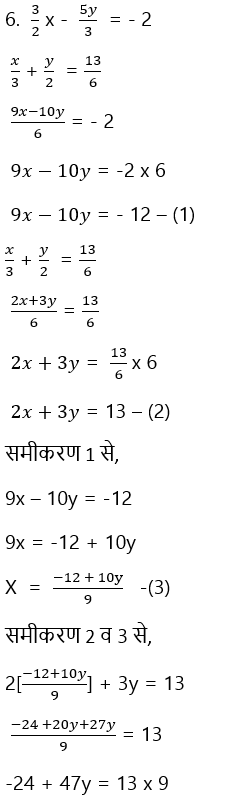
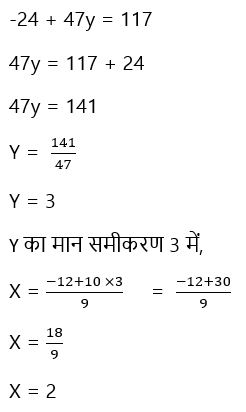
2. Solve the equations 2x + 3y = 11 and 2x – 4y = -24, and find the value of m for which y = mx + 3.
2x + 3y = 11 – (1)
2x – 4y = -24 – (2)
From equation 1,
2x + 3y = 11
2x = 11 – 34
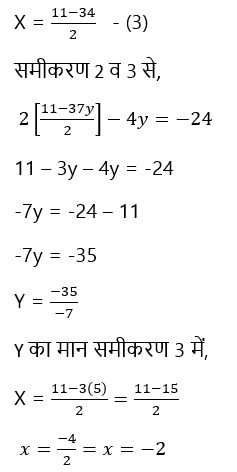
Y = mx + 3
5 = m( -2 ) + 3
5 – 3 = -2m
m = -1
3. Form a pair of linear equations in the following problems and find their solutions by the substitution method:
(i) The difference between two numbers is 26, and one number is three times the other. Find them.
Let the first number = x
Let the second number = y
As per the question,
X – y = 26 – (1)
X = 3y – (2)
From equations 1 and 2,
X – y = 26
3y – y = 26
2y = 26
Y = 13
Substituting the value of y into equation 3,
X = 3 x 13
X = 39
(ii) Of two supplementary angles, the larger angle is 18 degrees greater than the smaller angle. Find them.
Let the larger angle = x
Let the smaller angle = y
As per the question,
X + y = 180 –(1)
X = y + 18 – (2)
Substituting the value of x into equation 1,
18 + y + y = 180
2y = 180 – 18
2y = 162
Y = 81
Substituting the value of y into equation 2,
X = 81 + 18
X = 99
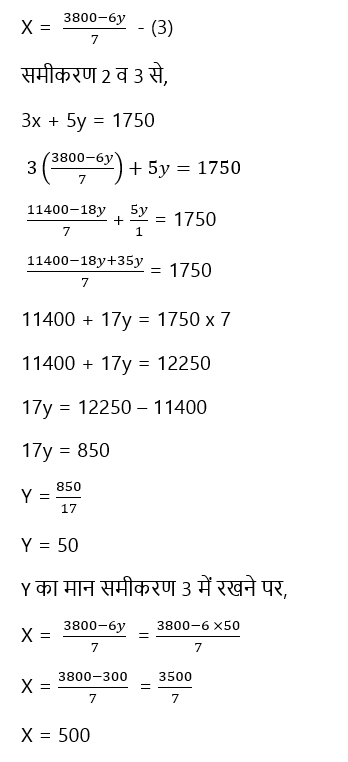
(iii) The coach of a cricket team purchased 7 bats and 6 balls for ₹3800. Later, he purchased 3 bats and 5 balls for ₹1750. Find the price of each bat and ball.
Let the price of one bat = ₹x
Let the price of one ball = ₹y
As per the question,
7x + 6y = 3800 – (1)
3x + 5y = 1750 – (2)
From equation 1,
7x + 6y = 3800
7x = 3800 – 6y
(iv) In a city, the taxi fare consists of a fixed charge plus a charge for the distance covered. The fare for a distance of 10 km is ₹105, and the fare for 15 km is ₹155. What are the fixed charge and the charge per kilometer? How much does a person have to pay for traveling a distance of 25 km?
Let the fixed charge = ₹x
Let the charge per kilometer = ₹y
According to the problem
X + 10y = 105 – (1)
X + 15y = 155 – (2)
From equation 1,
X + 10y = 105
X = 105 – 10y –(3)
From equations 2 and 3,
X + 15y = 155
105 – 10y + 15y = 155
5y = 155 – 105
5y = 50
Y = ₹10
Substituting the value of y into equation 3,
X = 105 – 10 x 10
X = 105 – 100
X = ₹5
According to the problem
X + 25y
5 + 25 x10
5 + 250
255 रूपये

Let the numerator of the fraction = Rs. x
Let the denominator of the fraction = Rs. y
As per the question,
X + 2 = 9
Y + 2 = 11
On multiplying by Vajra,
11( x + 2 ) = 9( y + 2 )
11x + 22 = 9y + 18
11x – 9y = 18 – 22
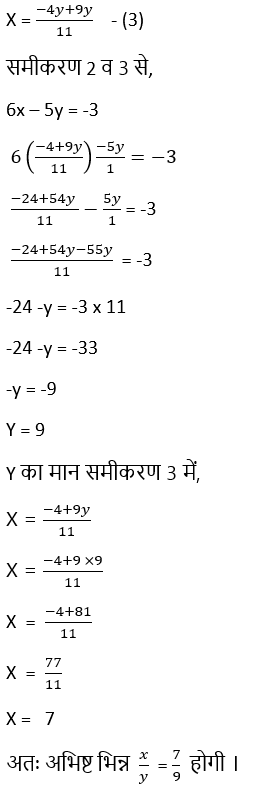
11x – 9y = – 4 -(1)
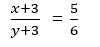
6 ( x+3 ) = 5 ( y+3 )
6x + 18 = 5y+15
6x – 5y = 15 – 18
6x – 5y = -3 – (2)
From equation 1,
11x – 9y = -4
11x = -4 + 9y
(vi) Five years from now, Jacob will be three times his son’s age. Five years ago, Jacob was seven times his son’s age. What are their present ages?
Let Jacob’s age = x years
Let the son’s age = y years
As per the question,
Five years from now,
X + 5 = 3( y + 5 )
X + 5 = 3y + 15
X – 3y = 10 – (1)
Five years ago,
X – 5 = 7( y – 5 )
X – 5 = 7y – 35
X – 7y = -35 + 5
X – 7y = -30 –(2)
From equation 1,
X – 3y = 10
X = 10 + 3y – (3)
From equations 2 and 3,
X – 7y = -30
10 + 3y -7y = -30
-4y = -30 -10
-4y = -40
Y = 10
From equation 3,
X = 10 + 3 x 10
X = 10 + 30
X = 40
Therefore, Jacob’s present age is 40 years, and his son’s age is 10 years.