
Quadratic equation Class 10th

Que. 1. Find the roots of the following quadratic equations by factorization method:
1. x2 – 3x – 10 = 0
x2 – 5x + 2x – 10 = 0
x (x – 5) + 2(x – 5) = 0
(x – 5) (x + 2) = 0
X – 5 = 0 x + 2 = 0
X = 5 x = -2
2. 2x2 + x – 6 = 0
2x2 + 4x – 3x – 6 = 0
2x (x + 2) – 3 (x + 2) = 0
(x + 2) (2x – 3)
X + 2 = 0 2x – 3 = 0
X = -2 2x = 3
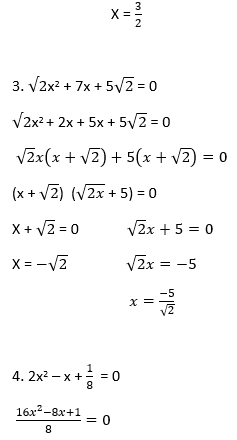
16x2 – 8x + 1 = 0 x 8
16x2 – 8x + 1 = 0
16x2 – 4x – 4x + 1 = 0
4x (4x – 1) – 1 (4x – 1) = 0
(4x – 1) (4x – 1)
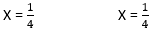
4x – 1 = 0 4x – 1 = 0
4x = 1 4x = 1
5. 100x2 – 20x + 1 = 0
100x2 – 10x – 10x + 1 = 0
10x (10x – 1) – 1 (10x – 1) = 0
(10x – 1) (10x – 1)
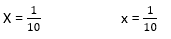
10x – 1 = 0 10x – 1 = 0
10x = 1 10x = 1
Que. 2. Solve the problems given in Example 1.
1. Let John have marbles – x
Let Javanti have marbles – 45 – x
As per the question,
Both lose five marbles –
John has marbles = x – 5
Javanti has marbles = 45 – x -5
= 40 – x
(x – 5) (40 – x) = 124
40x – x2 – 200 + 5x = 124
-x2 + 45x – 324 = 0
X2 – 45x + 324 = 0
X2 – 36x – 9x + 324 = 0
X (x – 36) – 9 (x – 36) = 0
(x – 36) (x – 9) = 0
X – 36 = 0 x – 9 = 0
X = 36 x = 9
2. Let the number of toys manufactured in a day = x
Cost of one toy = (55 – x) rupees
X (55 – x) = 750
55x – x2 = 750
55x – x2 -750 = 0
X2 -30x -25x +750 = 0
X (x -30) -25 (x -30) = 0
(x -30) (x -25) = 0
x -30 = 0 x -25 = 0
x = 30 x = 25
Que. 3. Find two numbers whose sum is 27 and their product is 182.
Let the first number = x
Let the second number = 27 – x
As per the question,
X x (27 – x) = 182
27x – x2 = 182
X2 – 27x + 182 = 0
X2 – 13x – 14x + 182 = 0
X (x – 13) – 14 (x – 13) = 0
(x – 13) (x – 14) = 0
X = 13 = 0 x – 14 = 0
X = 13 x = 14
Que. 4. Find two consecutive positive integers whose squares sum to 365.
Let the first positive integer be = x
Let the second positive integer be = x + 1
( x )2 + (x + 1)2 = 365
X2 + X2 + 2x + 1 = 365
2x2 + 2x + 1 – 365 = 0
2x2 + 2x – 364 = 0
2 (x2 + x -182) = 0
X2 + x – 182 = 0
X2 + x – 182 = 0
X2 + 14x – 13x – 182 = 0
X (x + 14) – 13 (x + 14) = 0
(x + 14) (x – 13) = 0
X + 14 = 0 x – 13 = 0
X = -14 x = 13
-14 is a negative value, so the first positive integer is 13 and the second positive integer is 14.
Que. 5. The height of a right triangle is 7 cm less than its base. If the hypotenuse is 13 cm, find the other two sides.
Let base of right angled triangle = x
Let height of right angled triangle = (x – 7)
Let hypotenuse of right angled triangle = 13 cm
From Pythagoras theorem,
(hypotenuse)2 = (base)2 + (perpendicular)2
(AC)2 = (BC)2 + (AB)2
(13)2 = (x)2 + (x – 7)2
169 = x2 + x2 – 14x + (7)2
169 = 2x2 – 14x + 49
2x2 – 14x + 49 – 169 = 0
2x2 – 14x – 120 = 0
2 (x2 – 7x – 60) = 0
X2 – 7x – 60 = 0/2 = 0
X2 – 12x + 5x – 60 = 0
X (x – 12) +5 (x – 12) = 0
(x – 12) (x + 5) = 0
X – 12 = 0 x + 5 = 0
X = 12 x = -5
Cancelling,
Base = x = 12 cm
Height = x – 7
= 12 – 7
= 5 cm
Que. 6. A cottage industry produces some number of pots per day. On one particular day, it was observed that the manufacturing cost (in ₹) of each piece was 3 times more than twice the number of pots manufactured that day. If the total manufacturing cost for that day was ₹90, find the number of pots manufactured and the cost of each piece.
Let the number of pots = x
Cost of a pot = 2x + 3
X (2x + 3) = 90
2x2 + 3x = 90
2x2 + 3x – 90 = 0
2x2 + 15x – 12x – 90 = 0
X (2x + 15) – 6 (2x + 15) = 0
(2x + 15) (x – 6) = 0
2x + 15 = 0 x – 6 = 0
2x = -15 x = 6
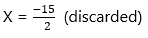
Number of pots x = 6
Cost of one pot = 2x + 3
= 2 x 6 + 3
= 15 rupees