
Quadratic Equation Solutions
Que. 1. Find the nature of the roots of the following quadratic equations. If roots exist then find them:

1. 2x2 – 3x + 5 = 0
ax2 + bx + c = 0
a = 2 , b = -3, c = 5
Nature of roots= b2 – 4ac
= (- 3)2 – 4 X 2 X 5
= 9 – 40
= -31 < 0
The origin is imaginary.
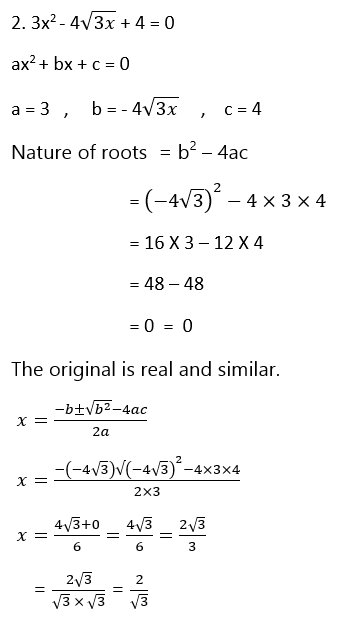
3. 2x2 – 6x + 3 = 0
ax2+ bx + c = 0
a = 2 , b = -6 , c = 3
Nature of roots = b2 – 4ac
= (-6)2 – 4 X 2 X 3
= 36 – 24
= 12 > 0
It is real and different.
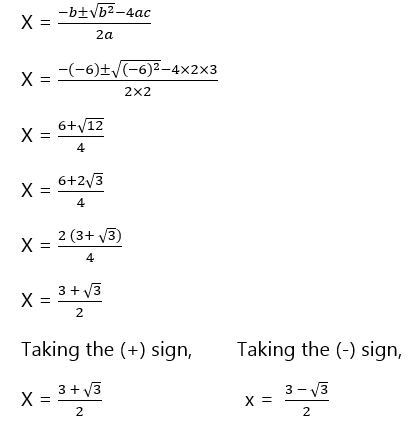
Que. 2. Find the value of k for each of the following quadratic equations so that they have two equal roots.
1. 2x2+kx + 3 = 0
a = 2 , b = k , c = 3
Both roots of the quadratic equation are equal.
b2 – 4ac = 0
k2 – 4 X 2 X 3 = 0
k2 – 24 = 0
k2 = 24

2. kx (x – 2) + 6 = 0
Kx2 – 2kx + 6 = 0
a = k , b = -2k , c = 6
If the roots of the equation are equal.
b2 – 4ac = 0
(-2k)2 – 4 X k X 6 = 0
4k2 – 24k = 0
4k (k – 6) = 0
4k = 0 k – 6 = 0
K = k = 6
Discarding this value,
Que. 3. Is it possible to design a mango grove whose length is twice its breadth and whose area is 800 m²? If so, find its length and breadth.
Let the width of the mango grove = x
Let the length of the mango grove = 2x
Area of the mango grove = 800 m²
Area of a rectangle = Length × Width
800 = 2x X x
800 = 2x2
X2 = 400
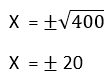
Width of the mango grove = x = 20 m
Length of the mango grove = 2x = 2 × 20 = 40 m.
Que. 4. Is the following situation possible? If so, determine their present ages.
The sum of the ages of two friends is 20 years. Four years ago, the product of their ages (in years) was 48.
Let the age of the friend = x years
Let the age of the other friend = (20 – x) years
Four years ago,
Age of the first friend = (x – 4) years
Age of the other friend = 20 – x – 4
= (16 – x)
According to the question,
(x – 4) (16 – x) = 48
16x – x2 – 64 + 4x = 48
-x2 + 20x – 64 = 48
X2 – 20x + 64 + 48 = 0
X2 – 20x + 112 = 0
a = 1 , b = -20 , c = 112
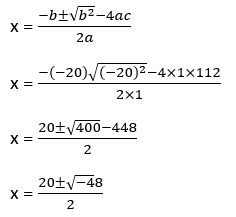
This is an imaginary value; therefore, this situation is not possible.
Que. 5. Is it possible to design a park with a perimeter of 80 m and an area of 400 m²? If so, find its length and breadth.
Let the length of the park = x
Let the width of the park = y
Perimeter = 80 m
Area = 400 m²
Perimeter of a rectangle = 2(l + b)
80 = 2 (x + y)
X + y = 40
Y = 40 – x – (1)
Area of a rectangle = 400 m2
L X b = 400
x X y = 400
From equation (1),
x X (40 – x) = 400
x2 – 40x + 400 = 0
a = 1 , b = -40 , c = 400
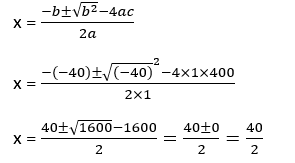
x = 20 m
Length = 20 m
Width = y = 40 – x
= 40 – 20
= y = 20m