
Introduction to Trigonometry
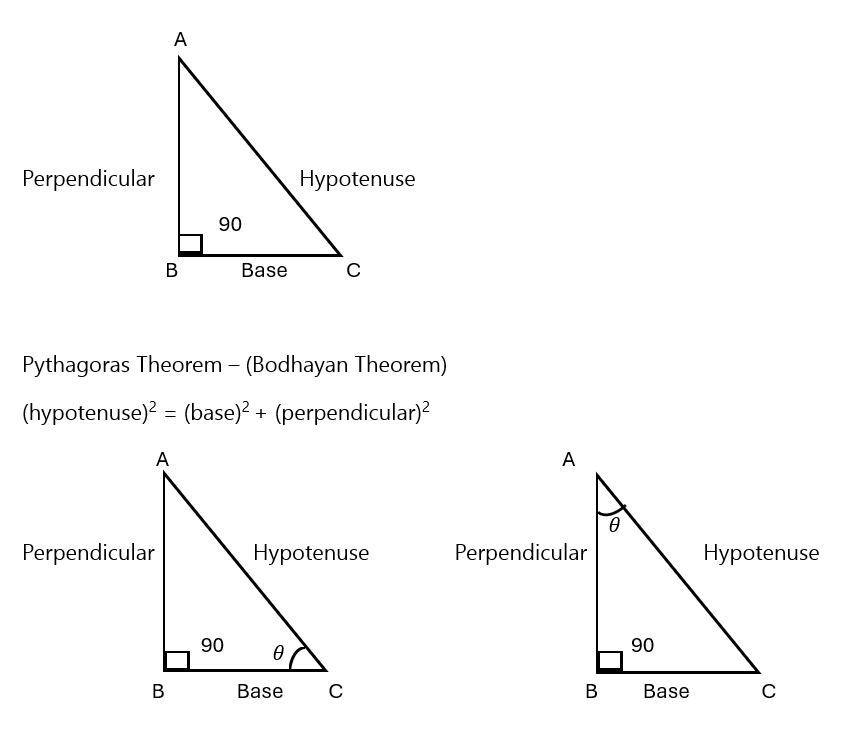
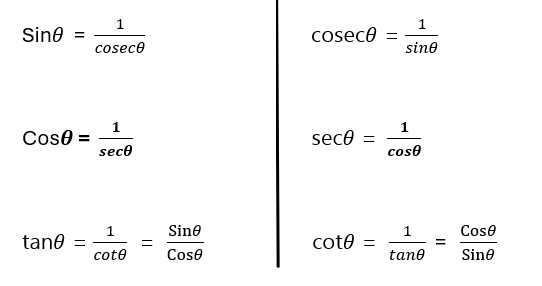

Que. 1. In triangle ABC, right-angled at B, AB = 24 cm and BC = 7 cm. Find the value of the following:
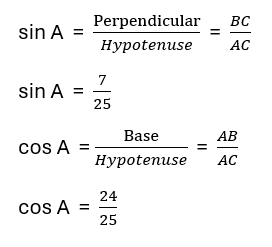
(i) sin A, cos A
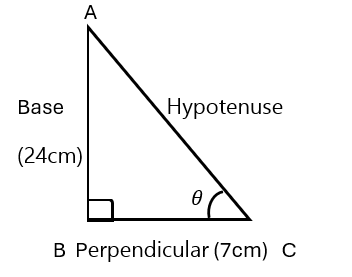
By Pythagoras theorem in triangle ABC,
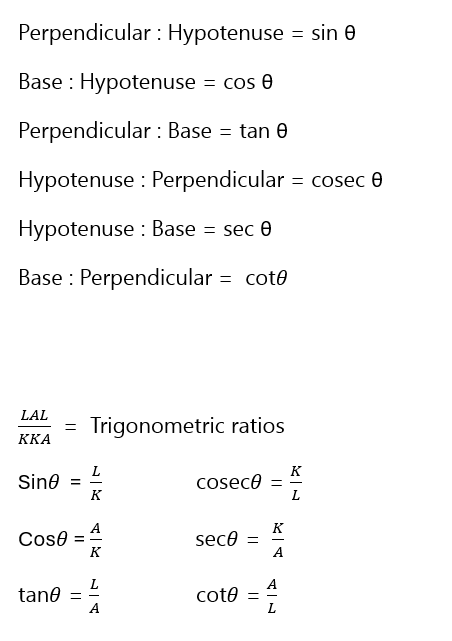
K2 = L2 + A2
(AC)2 = (BC)2 + (AB)2
AC2 = (7)2 + (24)2
AC2 = 49 + 576
AC2 = 625
AC = 25 cm
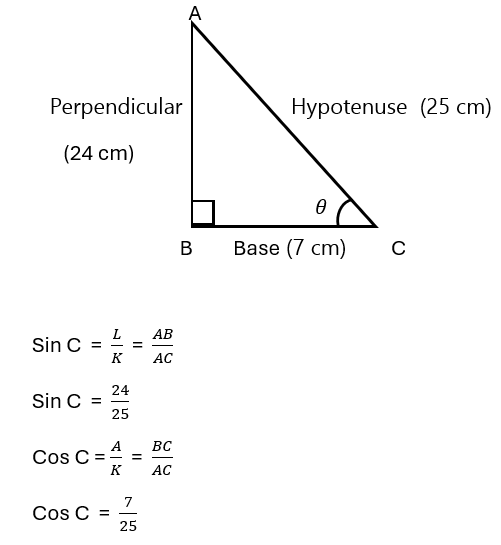
(ii) sin C, cos C
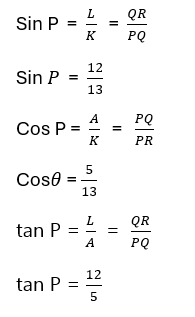
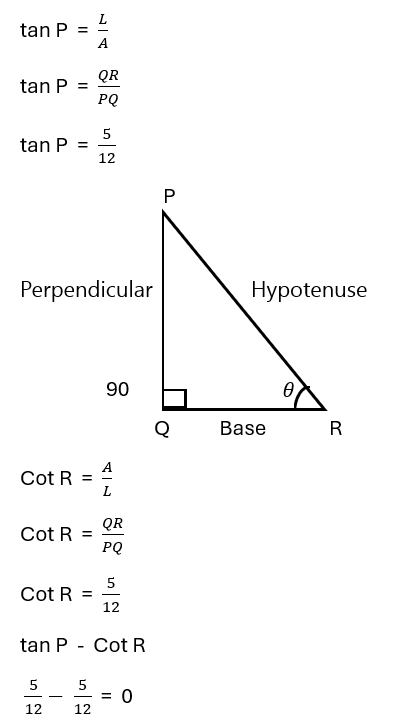
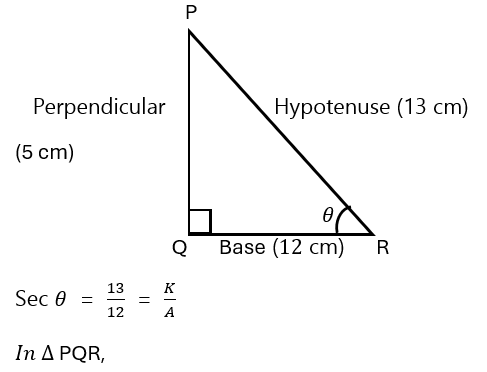
Que. 2. In the figure, find the value of tan P – cot R.
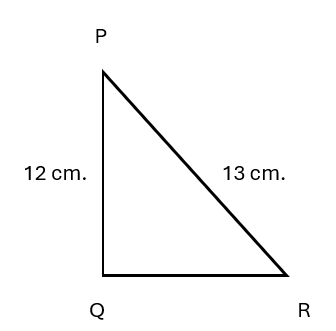
tan P – cot R
By Pythagoras theorem in triangle PQR,
K2 = A2 + L2
(PR)2 = (QR)2 + (PQ)2
(13)2 = (QR)2 + (12)2
169 = QR2 + 144
169 – 144 = QR2
25 = QR2
QR = 5 cm.
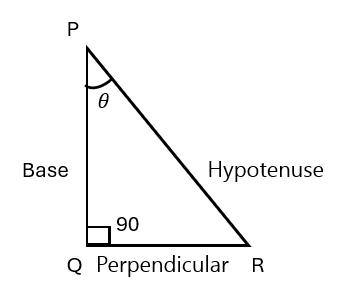
Que 3. If sin A = 3/4, calculate the values of cos A and tan A.
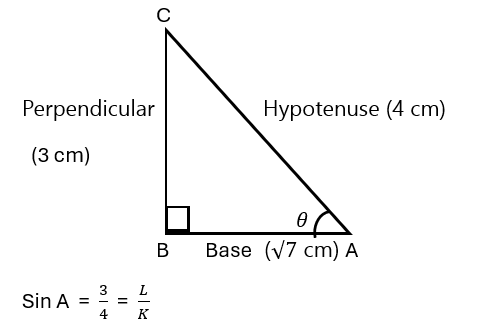
By Pythagoras theorem in triangle ABC,
K2 = A2 + L2
(AC)2 = (AB)2 + (BC)2
(4)2 = (AB)2 + (3)2
16 – 9 = AB2
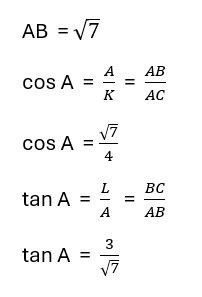
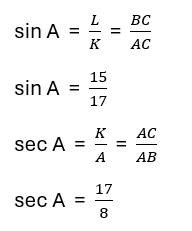
Que. 4. If 15 cot A = 8, find the values of sin A and sec A.
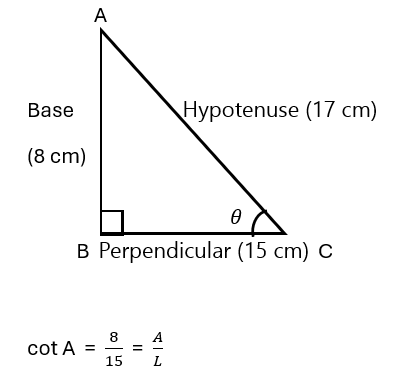
15 cot A = 8
By Pythagoras theorem in triangle ABC,
K2 = A2 + L2
(AC)2 = (AB)2 + (BC)2
(AC)2 = (8)2 + (15)2
AC2 = 64 + 225
AC2 = 289
AC = 17 cm.
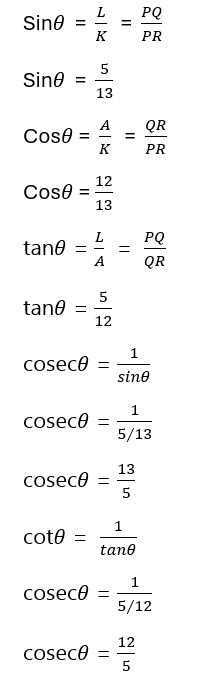
Que. 5. If
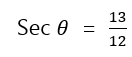
then calculate all other trigonometric ratios.
K2 = A2 + L2
(PR)2 = (QR)2 + (PQ)2
(13)2 = (12)2 + (PQ)2
169 = 144 + PQ2
169 – 144 = PQ2
PQ2 = 25
PQ = 5 cm
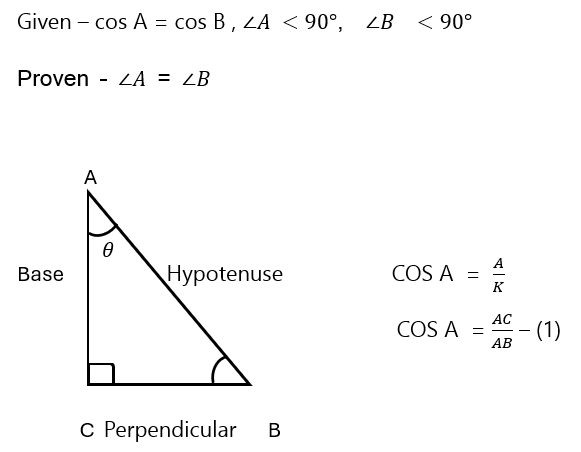
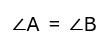
Que. 6. If angle A and angle B are acute angles such that cos A = cos B, then show that angle A = angle B.
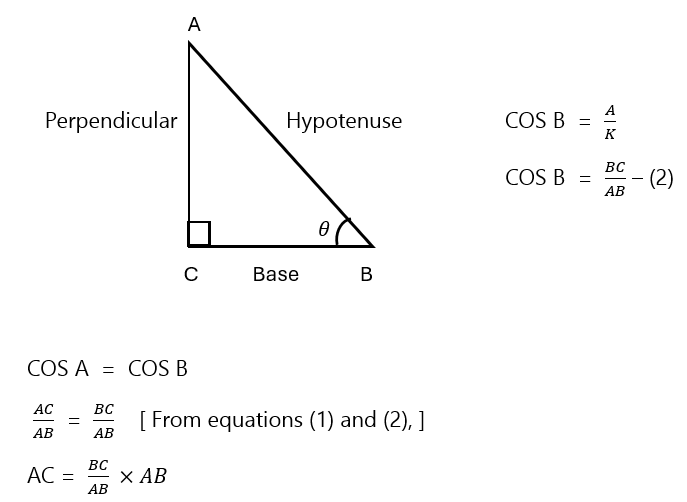
AC = BC
Angles opposite to equal sides are equal.
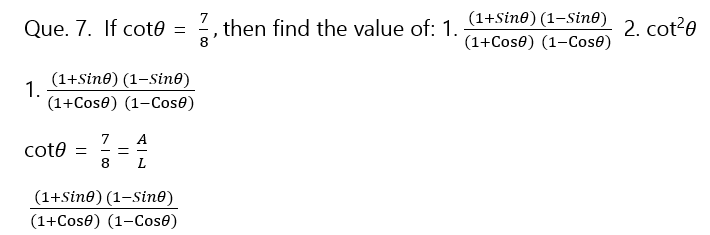
By Pythagoras theorem in triangle ABC
K2 = A2 + l2
(AC)2 = (BC)2 + (AB)2
AC2 = (7)2 + (8)2
AC2 = 49 + 64
AC2 = 113
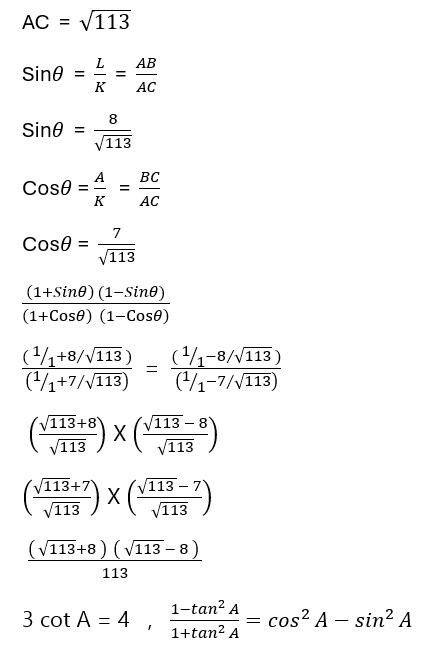
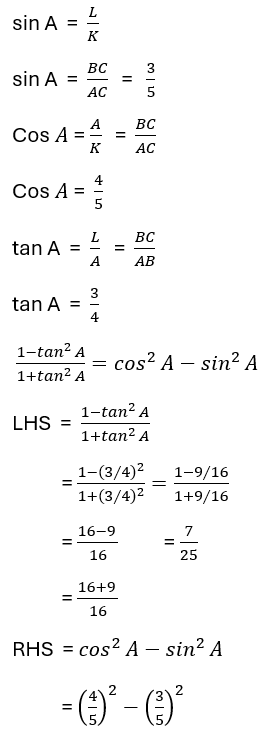
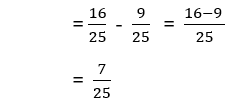
Que. 8. If 3 cot A = 4, check whether (1 – tan² A) / (1 + tan² A) = cos² A – sin² A or not.
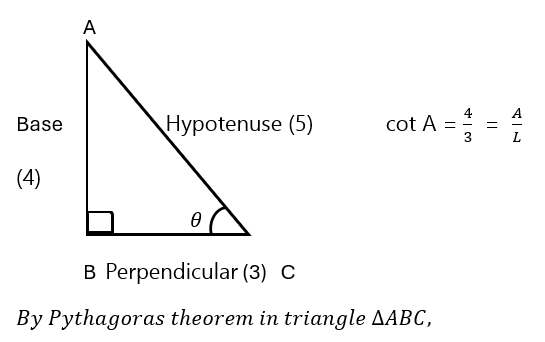
K2 = A2 + l2
(AC)2 = (AB)2 + (BC)2
AC2 = (4)2 + (3)2
AC2 = 16 + 9
AC2 = 25
AC = 5
Que. 9. In triangle ABC, right angled at B, if
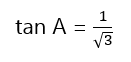
So, find the values of the following:
(i) sin A cos C + cos A sin C
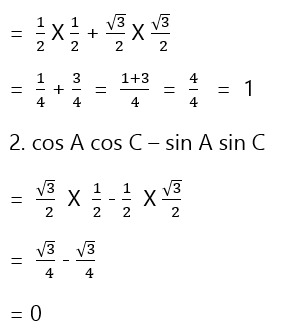
(ii) cos A cos C – sin A sin C
By Pythagoras theorem in triangle ABC,
K2 = A2 + L2
(AC)2 = (AB)2 + (BC)2
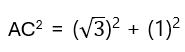
AC2 = 3 + 1
AC2 = 4
AC = 2
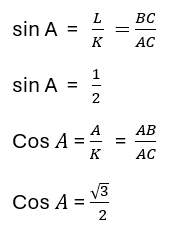
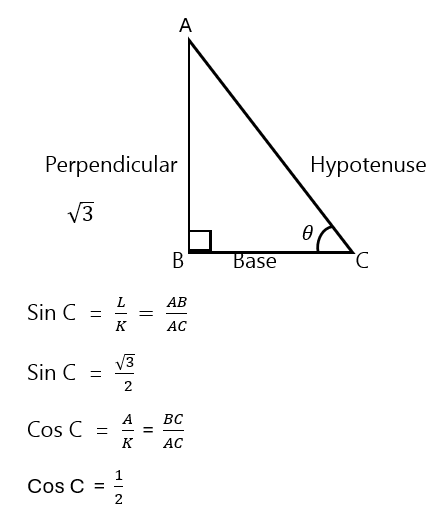
1. sin A cos C + cos A sin C
Que. 10. In triangle PQR, right-angled at Q, PR + QR = 25 cm and PQ = 5 cm. Find the values of sin P, cos P, and tan P.
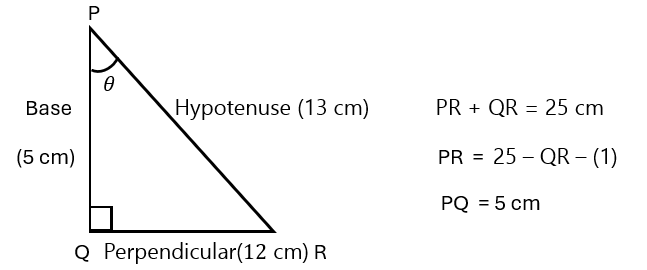
By Pythagoras theorem in triangle PQR,
K2 = A2 + L2
(PR)2 = (QR)2 + (PQ)2
From equation (1),
(25 – QR) = (5)2 + (QR)2
(25)2 – 2 X 25 X QR + (QR)2 = 25 + (QR)2
625 – 50 QR + (QR)2 – 25 + (QR)2 = 0
625 – 50 QR = 0
– 50 QR = – 600
QR = 12 cm
PR = 25 – QR = 25 – 12
= 13 cm