
Triangle Solutions
Que. 1. In figures (i) and (ii), DE || BC. Find EC in (i) and AD in (ii):

(i)
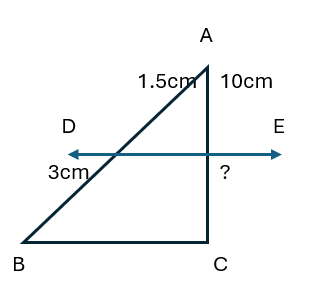
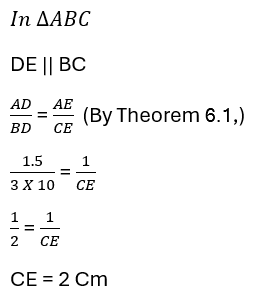
(ii)
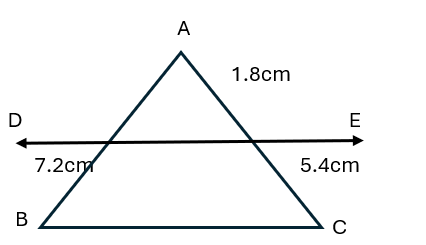
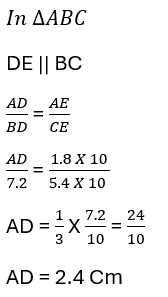
Que. 2. Points E and F lie on the sides PQ and PR, respectively, of a triangle PQR. State whether EF || QR:
1. PE = 3.9 Cm, EQ = 3 Cm, PE = 3.6 Cm, PR = 2.4 Cm
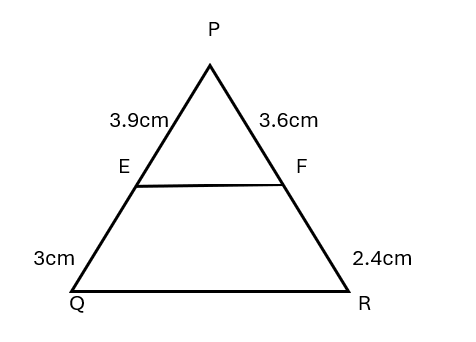
PE = 3.9 Cm
EQ = 3 Cm
PE = 3.6 Cm
PR = 2.4 Cm
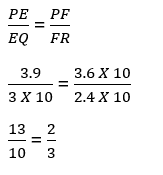
1.3 = 1.5
Hence, EF is not parallel to QR.
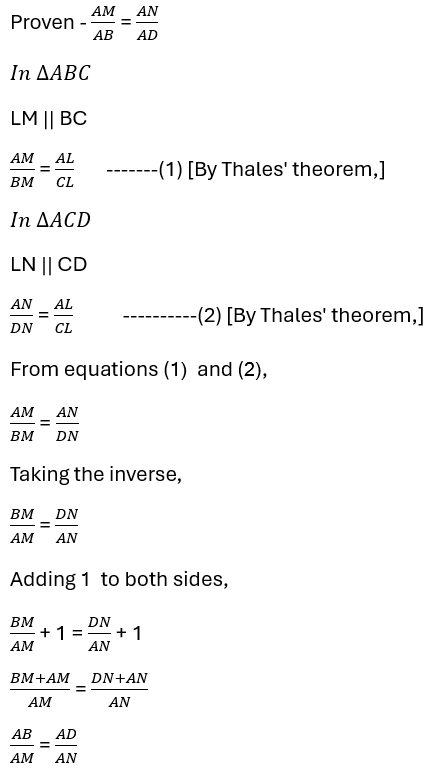
Que. 3. In the figure, if LM || CB and LN || CD, prove that AM/AB = AN/AD.
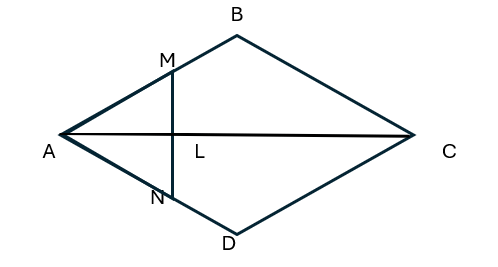
Given – LM || BC
LN || CD
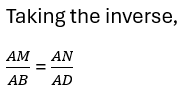
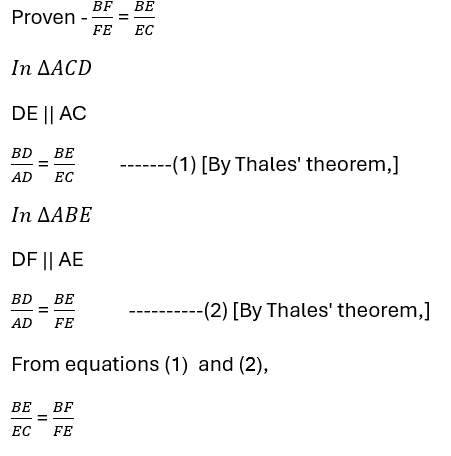
Que. 4. In the figure, DE || AC and DF || AE. Prove that BF/FE = BE/EC.
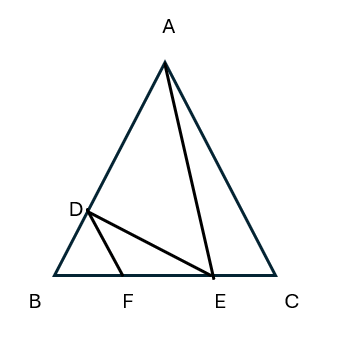
Given – DE || AC
DF || AE
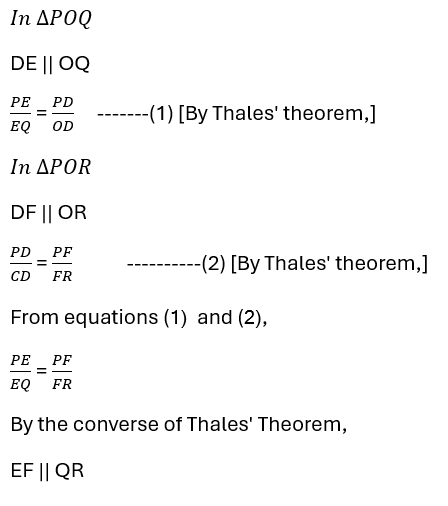
Que. 5. In the figure, DE || OQ and DF || OR. Show that EF || QR.
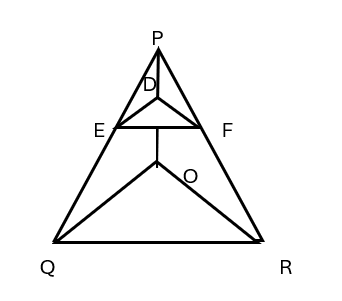
Given – DE || OQ
DF || OR
Proven – EF || QR
Que. 6. In the figure, points A, B, and C lie on OP, OQ, and OR respectively, such that AB || PQ and AC || PR. Show that BC || QR.
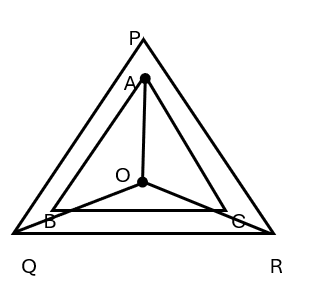
Given – AB || PQ
AC || PR
Proven – BC || QR
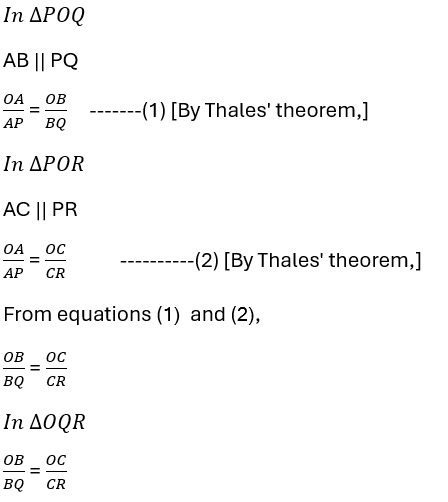
By the converse of Thales’ Theorem,
BC || QR
Que. 7.Using Theorem 6.1, prove that a line drawn through the midpoint of one side of a triangle parallel to another side bisects the third side.
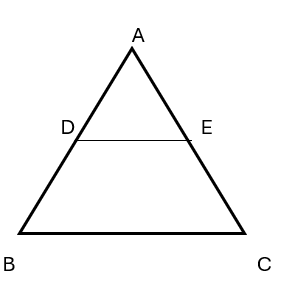
Given – AD = BD ——(1)
DE || BC
Proven – AE = EC
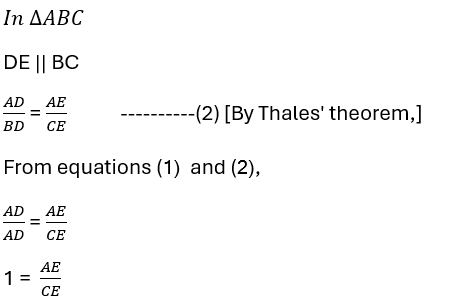
CE = AE
Que. 8. Using Theorem 6.2, prove that the line joining the mid-points of any two sides of a triangle is parallel to the third side.
Given – AD = BD
AE = CE
Proven – DE || BC
AD = BD
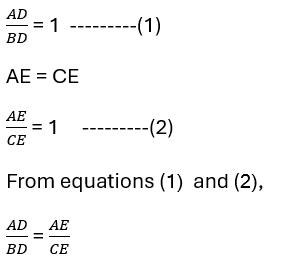
By the converse of Thales’ Theorem,
DE || BC
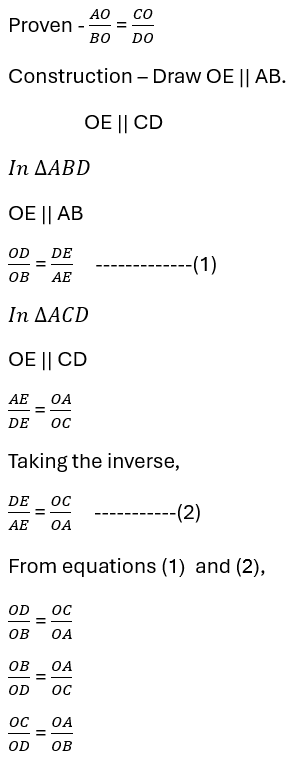
Que. 9. ABCD is a trapezium in which AB || DC, and its diagonals intersect each other at point O. Show that AO/BO = CO/DO.
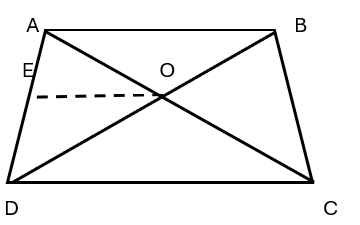
Given – ABCD is a trapezium.
AB || CD
Que. 10. The diagonals of a quadrilateral ABCD intersect each other at point O such that AO/BO = CO/DO. Show that ABCD is a trapezium.
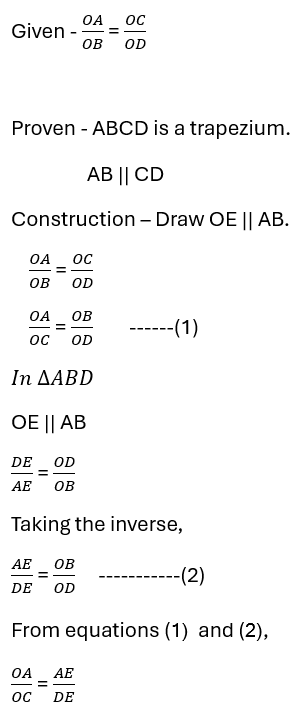
By the converse of Thales’ Theorem,
OE || CD
Therefore, AB || CD.