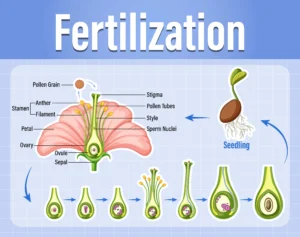

Post-fertilization Structures and Events.
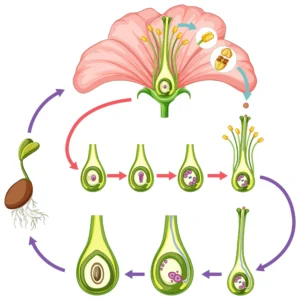
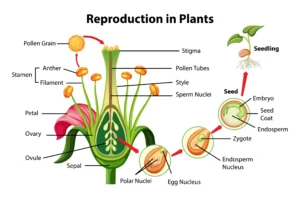
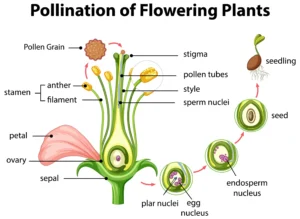
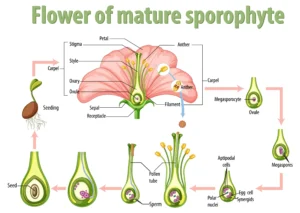
All the events involving the maturation of the ovule into a seed and the development of the ovary into a fruit are collectively referred to as post-fertilization events.
Endosperm.
The development of the endosperm precedes the development of the embryo. The primary endosperm cell undergoes repeated divisions to form a triploid endosperm tissue. The endosperm is filled with stored food materials and provides nutrients to the developing embryo. The primary endosperm nucleus undergoes successive nuclear divisions to produce free nuclei; this stage of endosperm development is known as free nuclear endosperm. Subsequently, cell walls are formed, and the endosperm becomes cellular.
Example- In a tender coconut, the coconut water represents the [free nuclear endosperm], while the white kernel (flesh) represents the [cellular endosperm].
- In some seeds, the endosperm is completely consumed by the developing embryo before the seed matures.
- Examples– Pea, Groundnut, and Bean.
- In other seeds, the endosperm persists even after the seed has matured.
- Examples– Castor and Coconut.
Embryo.
The diploid zygote undergoes unequal division, resulting in the formation of a suspensor cell towards the upper side and a basal cell towards the lower side. The suspensor cell is oriented towards the chalaza, while the basal cell is oriented towards the micropyle. Through longitudinal divisions within the suspensor cell, a filament consisting of 6 to 10 suspensor cells is formed. Transverse divisions within the basal cell give rise to an octant stage (eight-celled structure). The zygote develops into an embryo; in the course of its development, it progresses through globular, heart-shaped, and finally, mature stages.
Epicotyl– The portion of the main axis situated above the point where it attaches to the cotyledons. It typically terminates at the plumule (shoot apex).
Hypocotyl – The portion of the main axis (embryonic axis) located below the cotyledon, at the point where it attaches to the cotyledon. The lower end terminates at the radicle. The radicle is covered by a protective sheath known as the root cap.
Development of a Monocot Embryo – The single cotyledon is known as the scutellum. There is typically only one suspensor cell. At the lower end of the embryonic axis, the radicle is enclosed within a protective sheath called the coleorhiza. In a monocot embryo, a hollow, leaf-like structure found above the plumule is known as the coleoptile.
Seed.
Following fertilization, the ovule undergoes numerous changes, ultimately resulting in the formation of a seed.
Non-albuminous (Exalbuminous) Seeds– In many seeds, the endosperm is absent because it is completely consumed by the developing embryo during its growth; such seeds are termed non-albuminous (or exalbuminous).
Examples. Gram (Chickpea), Pea.
Albuminous Seeds – In some seeds, the endosperm persists; these are referred to as endospermic or albuminous seeds.
Examples. Maize, Wheat, Castor.
Perisperm – In certain seeds, the nucellus remains present; the persistence of the nucellus in a residual form is termed perisperm.
Examples. Black Pepper, Beetroot.
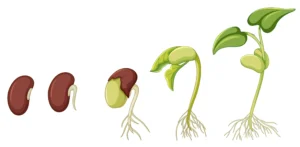
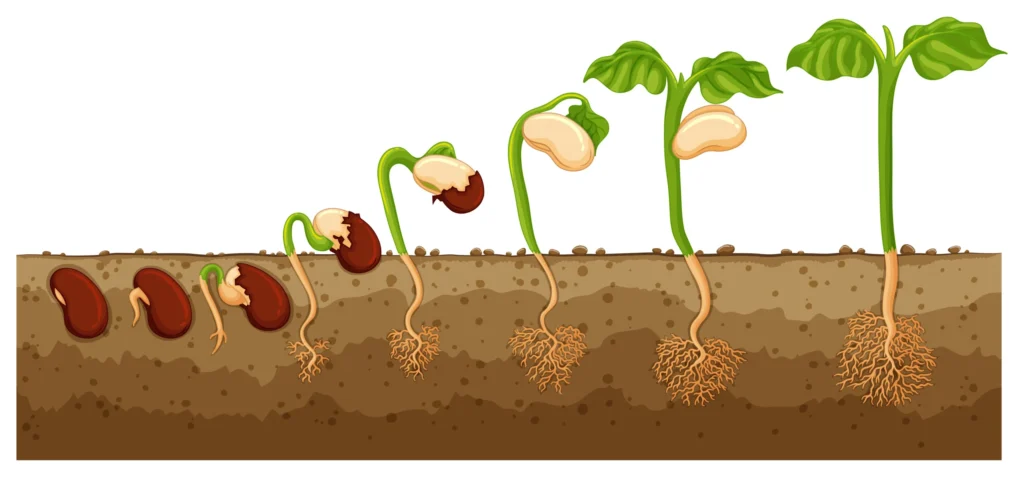
Dormancy – As the ovule matures into a seed, its water content gradually decreases, causing the seed to become dry. Metabolic activity slows down significantly, and the seed enters a state of inactivity; this condition is known as dormancy. Under favorable environmental conditions, the seed germinates.
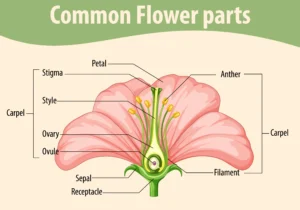
Fruit – The maturation of the ovule and the ovary occurs simultaneously. The ovule transforms into a seed, while the ovary develops into a fruit. The wall of the ovary evolves into the fruit wall, which is known as the pericarp.
False Fruits (Accessory Fruits)– In certain species, structures other than the ovary—specifically the thalamus(receptacle)—play a significant role in the formation of the fruit; such fruits are termed false fruits.
Examples. Apple, Strawberry, Walnut.
True Fruits– Fruits that develop exclusively from the ovary are classified as true fruits.
Examples. Mango, Grape, Coconut.
Parthenocarpic Fruits– Fruits that develop into mature fruits without undergoing fertilization are known as parthenocarpic fruits.
Example. Banana.
Advantages of Seeds.
- The reproductive processes, such as pollination and fertilization, are independent of external agents like water; the structure of the seed itself is highly self-reliant.
- Seeds possess adaptive strategies that facilitate their dispersal into new habitats.
- They assist species in colonizing and establishing themselves in new geographical regions.
- Seeds provide nourishment to the developing seedling until it becomes capable of performing photosynthesis on its own.
- The hard seed coat offers protection to the delicate young embryo.
- As products of sexual reproduction, seeds generate novel genetic combinations, thereby contributing to genetic diversity.
Seed Viability.
Seed viability refers to the duration for which a seed retains the capacity to germinate. The viability of some seeds expires within just a few months, while others remain viable for many years. An ancient example is the seed of Lupinus arcticus, which was excavated from the Arctic Tundra; it holds the record for germinating and flowering after an estimated dormancy period of 10,000 years. A more recent record involves a 2,000-year-old viable date palm seed (Phoenix dactylifera), which was discovered during an archaeological excavation of King Herod’s palace near the Dead Sea.
Note. Orchid fruits—such as the fig (Ficus)—contain 1,000 minute seeds. Some parasitic species, such as Orobanche and Striga, also produce such fruits; from a single tiny seed, a massive plant develops.
Apomixis and Polyembryony.
Apomixis — The formation of an embryo or seed without fertilization is known as apomixis.
Examples. Asteraceae and grasses.
Apomixis is a form of asexual reproduction that mimics sexual reproduction. Any cell within the embryo sac (such as the egg cell, synergid, or antipodal cell) can develop into an embryo. In some species, a diploid egg cell is formed without undergoing meiosis, and this cell subsequently develops into an embryo without fertilization.
Polyembryony — In the Citrus genus and in mangoes, the nucellar cells surrounding the embryo sac begin to divide and develop into embryos. The presence of more than one embryo within a single seed is termed polyembryony. This phenomenon is commonly observed in gymnosperms. In seeds exhibiting polyembryony, typically only one embryo eventually matures, while all the others degenerate.