
Pollination.
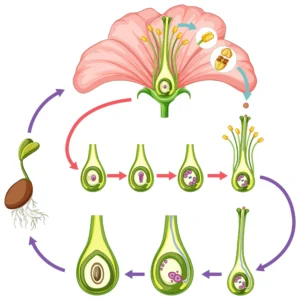
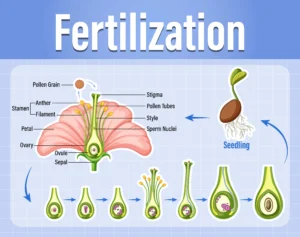
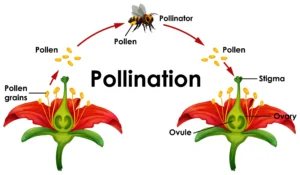
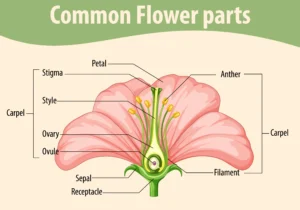
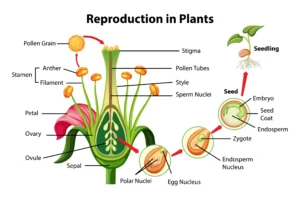
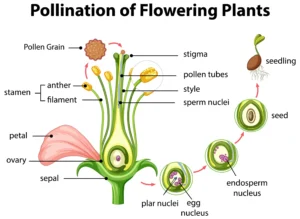
The transfer of pollen from the anther to the stigma of the pistil is called pollination.
Types of Pollination:
1. Autogamy
2. Homogamy
3. Cross-Fertilization
Autogamy – When pollen is transferred to a flower of the same plant, it is called autogamy.
This type of pollination occurs in only one flower. For autogamy to occur, the pollen and stigma must be synchronized. Furthermore, the anthers and stigma must be located close to each other.
Examples. Viola, Oxalis, and Commelina.
white pollinated flowers – These are similar to normal flowers. The anthers and stigma are exposed.
non-pollinated flowers – In some plants, the flowers are always closed. The anthers and stigma are not exposed. Autogamy is essential in these plants. The anthers and stigmas are very close to each other. These flowers are always autogamous because there is no opportunity for cross-pollination.
Geitonogamy– When pollen grains land on the stigma of another flower on the same plant, it is called homogamous pollination. This requires a factor. Homogamous pollination is similar to autogamy, as the pollen grains land on the flower of the same plant.
(Factors – water, wind, bees, birds, insects, humans)
Note – Functionally, cross-pollination is genetically self-pollination.
Xenogamy – In cross-fertilization, the transfer of pollen grains from the flower of one plant to the stigma of the flower of another plant is called cross-fertilization. Cross-fertilization requires a factor.
Agents of Cross-Fertilization – There are two types of agents or agents of cross-fertilization:
1. Abiotic Agents – Wind/Water
2. Biotic Agents – Bees, Butterflies, Birds
Abiotic Agents.
Air Pollination – This is the most common form of pollination. In this, pollen grains must be light and non-sticky so that they can be transmitted by wind. The stigma must be long and the stigma sticky. In air pollination, each ovary contains a single ovule. The anthers are equipped with exposed stamens so that they can easily fly in the wind. The stigmas are often large so that they can easily catch wind-blown pollen.
Examples. Corn (in this case, wind-blown pollen grains are caught by the silken stigma) and grasses and pines.
Water Pollination – Pollination by water is quite rare in flowering plants. It is limited to only 30 genera, mostly monocotyledonous plants. Bryophyta and Pteridophyta are less common because water is required for pollen transport and fertilization.
Example. Vallisneria, Zostera (they pollinate underwater).
In another type of aquatic pollination, the female flowers are raised to the surface of the water by a long stalk, and pollen grains are released on the surface. Some accidentally reach the stigma.
Example. Vallisneria
In another type of aquatic pollination, the female flowers remain submerged, and pollen grains are released in the water, and some of them perform fertilization. Pollen grains should be light and have a waxy coating. The stigma should be long, and the stigma should be sticky and have a waxy coating.
Example. Sycamores
Note: Not all aquatic plants use water for pollination. Most aquatic plants grow on the surface of water and are pollinated by insects and wind.
Example. Water Hyacinth and Winter Lily
Biotic Agents.
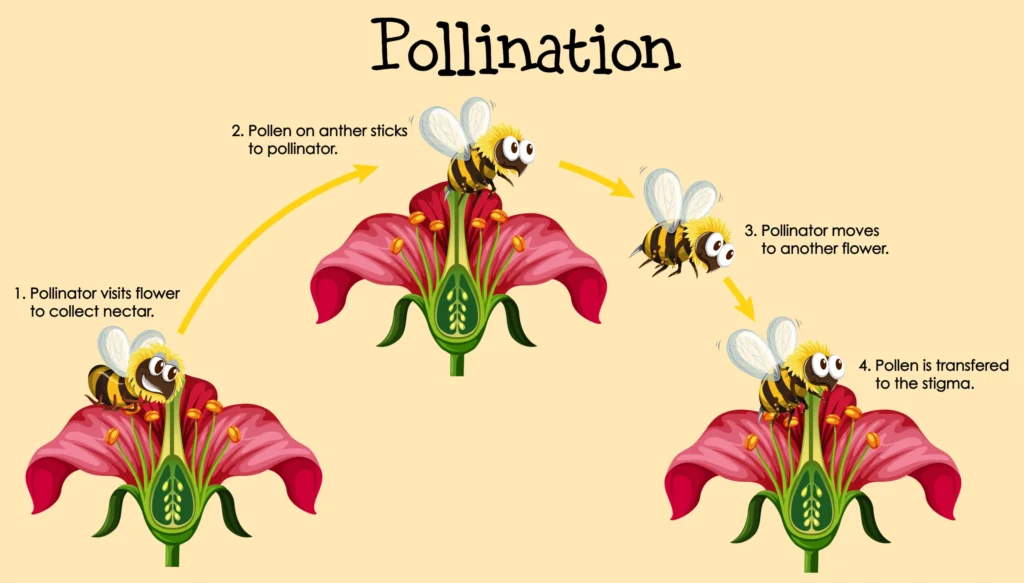
Insects such as bees, flies, butterflies, and birds pollinate. 80% of insect pollination is done by bees. Some larger male animals, such as lemurs, arboreal and gecko lizards, and garden lizards, also perform pollination to some extent. Flowers must be colorful, fragrant, and contain nectar for insect pollination. Flowers pollinated by beetles have a foul odor, which attracts these insects. Flowers typically offer nectar and pollen as rewards. To obtain this reward, insects come into contact with the stigma and anther. A coating of pollen forms on the insect’s body, and when this insect comes into contact with the stigma, pollination is complete.
Example. Hummingbirds
In some flowers, this reward comes in the form of egg-laying. A relationship exists between a species of moth and a yucca plant. The two cannot survive without each other. In this, the moths lay their eggs in the flower’s ovary.
For example, the 6-foot-tall Amorphophallus flower.
Outbreeding Devices.
Most flowering plants are bisexual. Continuous self-pollination prevents inbreeding. In some species, the maturation times of the anther and stigma are not the same, preventing pollen from the same plant from coming into contact with the stigma. Therefore, both devices prevent autogamy. In some species, the anther and stigma are located in different locations, preventing them from coming into contact with each other. A third means of preventing inbreeding is self-incompatibility, which is an inherited process. Pollen from another flower on the same plant prevents germination or pollen growth in the pistil. One way to prevent self-pollination is to breed monoecious plants, such as castor and maize.
Note. In papaya, male and female flowers are on separate plants, meaning each plant is either male or female.
Pollen-Pistil Interaction.
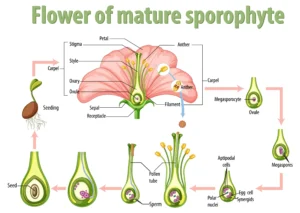
Pollination does not ensure that the appropriate pollen of the particular species reaches the stigma. The pistil has the ability to recognize and accept the correct pollen of the same species. If the wrong pollen reaches the stigma, the stigma rejects it, preventing pollen germination or pollen tube growth in the stigma. In some plants, pollen grains shed their two-celled state (vegetative and generative cells). The generative cell divides and forms two male gametes during pollen tube growth in the stigma. After reaching the ovary, the pollen tube enters the ovule through the micropyle. It enters a synergistic cell within the ovule through a filamentous assembly. This filamentous assembly guides the pollen tube. The process from the time the pollen grain is attached to the stigma to the pollen tube entering the ovule is called pollen-pistil interaction.
Artificial Hybridization – Artificial hybridization is performed to prevent self-pollination in bisexual flowers.
Emasculation – To prevent self-pollination in bisexual flowers, the stamens are removed with forceps before they mature; this is called emasculation.
Bagging – The emasculated flower is covered with a butter paper bag to protect the stigma from unwanted pollen; this is called bagging.
Double Fertilization (Double Insemination).
After entering the subsidiary cell, the pollen tube releases two male gametes into the subsidiary cell’s cytoplasm. One male gamete moves toward the egg cell and fuses with the nucleus, resulting in gamete fusion and the formation of a diploid (2n) zygote. The second male gamete fuses with the secondary nucleus and forms the primary endosperm nucleus. This involves three haploid nuclei (3n), this is called triple fusion. This phenomenon of two types of fusion, gamete fusion and triple fusion, in one endosperm is called double fertilization. After triple fusion, the central cell becomes the primary endosperm cell and develops into the endosperm. The zygote develops into an embryo.