What is a Database?
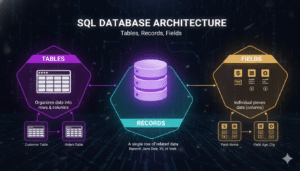
A database is a collection of user-defined, custom-created data stored in a structured order consisting of rows, columns, fields, and tables. It is stored and managed in a tabular format using online or offline software, allowing easy access and retrieval of database information, manipulation, and storage in a secondary storage location. A database system organizes, manages, and displays user-created data. Database administrators process data tables, rows, and columns to efficiently store large volumes of tabular databases, or perform administrative tasks such as searching for database table records, updating records in a data table, and deleting existing data records.
Management of user-created or system-generated databases is typically managed and processed by database management software (DBMS), which are software tools or applications that help database users or administrators easily create, update, maintain, and manage or process data tables.
What are the main types of databases?
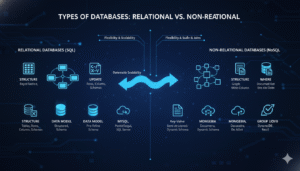
- Relational databases (RDBMS) – Relational databases store system-generated data in a row and column structured or formatted order. Relationships between database tables are established using table, row, column, common field keys, such as MySQL, PostgreSQL, and Oracle database software.
- NoSQL databases – NoSQL databases are designed and developed to provide users or database administrators with more complex data storage models. NoSQL databases are mostly used in unstructured or semi-structured databases, such as MongoDB and Cassandra.
- In-memory databases – In-memory databases store data in RAM rather than primary memory for fast access and retrieval, such as Redis, Memcached, etc.
Key characteristics of a database.
- Data integrity – It ensures the accuracy and consistency of system-generated data for table rows and columns in the data.
- Data security – It protects existing data data from unauthorized access.
- Data redundancy control – It minimizes duplicate data storage entries in a database system to optimize data storage and improve data performance.
- Scalability – It provides database system software with the ability to efficiently store and manage large volumes of user- or system-generated data.
Databases are now essential to many applications, from basic online shopping platforms to financial systems. Database storage and retrieval are essential processes in every field. Database software or methods are crucial for reliable and efficient data table records management.
Example of a Simple employee Data Table.
employee table.
| emp_id | First_name | Last_name | Contact | |
| 1 | Siddhi | Deora | siddhi@domain.com | +91 – 999911111 |
| 2. | Harry | Deora | harry@domain.com | +91 – 888811111 |
| 3. | Ajay | Mehata | ajay@domain.com | +91 – 777711111 |
| 4. | Vinay | Saxena | vinay@domain.com | +91 – 666611111 |
Example employee SQL Data Schema.
E-commerce sql table schema
CREATE TABLE employee (
id INT PRIMARY KEY AUTO_INCREMENT,
emp_name VARCHAR(120),
email VARCHAR(255) UNIQUE,
contact decimal
);
CREATE TABLE product (
id INT PRIMARY KEY AUTO_INCREMENT,
prod_name VARCHAR(150),
prod_price DECIMAL(10,2),
stock INT
);
CREATE TABLE order (
id INT PRIMARY KEY AUTO_INCREMENT,
employee_id INT,
order_date TIMESTAMP DEFAULT CURRENT_TIMESTAMP,
FOREIGN KEY (emplyee_id) REFERENCES employees(id)
);
CREATE TABLE order_items (
order_id INT,
product_id INT,
quantity INT,
PRIMARY KEY (order_id, product_id),
FOREIGN KEY (order_id) REFERENCES order(id),
FOREIGN KEY (product_id) REFERENCES product(id)
);