

Types of Databases Relational vs. Non-Relational
Database systems are generally divided into two main categories, known as relational databases and non-relational databases, based on their default storage method, schema structure, and management system processes.
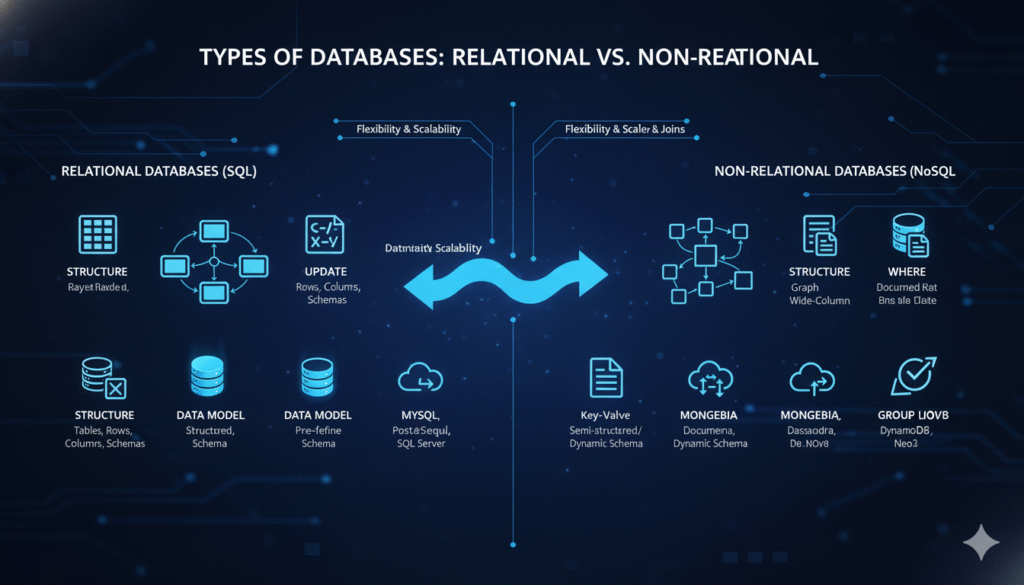
So, let’s understand relational databases and non-relational databases in SQL better.
Relational Databases (RDBMS) in SQL.
A relational database stores data and information in a relational database. A relational database relates two different tables with similar common fields. Data tables and columns, also known as relational tables, are connected in a table format to establish a relationship, or connect them. In a relational database, table records are connected to each other through relations using foreign keys. The Structured Query Language (SQL) software is used to query and manage data and information in an RDBMS database.
Key Features of Relational Databases (RDBMS).
- Tables – Database data is stored in tables consisting of rows and columns. Each table row represents a record, and each table column represents an attribute or field.
- Schema – The database table structure (schema) is predefined and fixed in nature. Relationships between database table rows or column fields are established using primary keys and foreign keys.
- ACID Properties – RDBMSs in database systems ensure that database transactions have the ACID properties of atomic, consistent, isolated, and durable, ensuring the integrity and reliability of data information.
- Normalization – To reduce data redundancy and dependency in a database, data is often subjected to a multiple-step normalization process.
Examples of Relational Databases (RDBMS).
MySQL Database
PostgreSQL Database
Oracle Database
Microsoft SQL Server Database
SQLite Database
Relational Databases (RDBMS) Use Cases.
Tables containing structured data in relational database tables, such as financial systems, customer relationship management (CRM) systems, and inventory systems, are a common use case.
A top use case involves database administrators managing applications that require reliability and consistent transactions.
Advantages of Relational Databases (RDBMS).
- Relational databases help maintain data integrity and accuracy.
- Relational databases provide strong consistency and database transactional support.
- Relational databases offer established query and reporting standard features, displayed through SQL software.
Disadvantages of Relational Databases (RDBMS).
- Scalability in databases can sometimes be challenging, especially when database administrators are dealing with large-volume database datasets.
- A typical user must be careful when modifying database table schemas, as this may not be flexible for highly dynamic data models.
Non-relational databases (NoSQL).
Non-relational databases, often referred to as NoSQL databases, are designed for scalable data storage with a more flexible nature. Non-relational databases do not rely on tabular data structure formats like relational databases and can primarily store and process unstructured, semi-structured, or structured data in multiple formats.
Key features of non-relational databases.
- Schema-less – non-relational databases do not require any predefined schema. Data can be inserted or added without any specific structure, making non-relational databases flexible for immediate modification.
- Horizontal scaling – non-relational databases can be easily controlled or scaled across multiple online servers, making them suitable for large-volume data applications and distributed systems.
- Different data models – non-relational databases fully support multiple data models, including document-based, key-value, graph-based, or column-family storage.
Types of non-relational databases.
Document non-relational databases.
These database formats store and process data in document formats such as JSON, BSON, or XML.
Each document can have its own unique storage structure and format extension.
Examples – MongoDB, CouchDB
Key-value non-relational databases.
These databases store data as a key-value pair structure, where each database has its own unique key value.
Examples – Redis, DynamoDB
Column-family non-relational databases.
These databases store data in a columnar format rather than rows, which is the best method for storing and analyzing large volumes of data.
Examples – Cassandra, HBase
Graph non-relational databases.
These databases use a graph structure to store data, with nodes representing entities and edges representing relationships.
Examples – Neo4j, ArangoDB
Example of non-relational databases.
MongoDB
Cassandra
Redis
CouchDB
Amazon DynamoDB
Neo4j
Non-relational database use cases.
- Big data – non-relational databases are the best choice for high-volume, high-velocity data.
- Unstructured or semi-structured data – This is database data that doesn’t fit properly into a table, such as social media posts, logs, or sensor data.
- Real-time analytics – non-relational databases are used for applications that require fast access and real-time data processing, such as recommendation engines, IoT, and social media networks.
- Highly scalable and flexible systems – non-relational databases include systems that need to scale horizontally or support dynamic schema modification.
Advantages of non-relational databases.
- Non-relational databases offer high scalability and performance, especially for large, distributed data.
- Non-relational databases allow users to create flexible schemas, dynamically evolve data models, and adapt to specific use cases.
- Non-relational databases make it easier to customize them for specific use cases, such as caching, real-time analytics, and storing and processing large data volumes.
Disadvantages of non-relational databases.
- Lack of consistency in non-relational databases. Some NoSQL systems follow eventual consistency instead of strict ACID properties.
- Non-relational databases have a less mature query language than SQL databases, and lack a standard query language.
- Management of non-relational databases can be more complex for applications that rely on relational integrity.
Comparison of Relational vs Non-Relational Databases Type.
| Feature | Relational Databases (RDBMS) features | Non-Relational Databases (NoSQL) features |
| Database Structure | It stores and process data in Tables rows and columns format | It stores and process database in Varies key-value, documents, columns, graphs format. |
| Database Schema | Relational Databases have its own Fixed schema format | Non-Relational Databases don’t haveSchema-less or flexible |
| Query Language | Relational Databases support and use access control by SQL software | Non-Relational Databases support by Varies MongoDB Query Language, CQL, Gremlin, etc. software. |
| ACID Transactions | Relational Databases support acid transaction features | Non-Relational Databases Varies some offer eventual consistency features |
| Scalability features | Rdbms database provide Vertical scaling more resources to one server features | NoSQL database support Horizontal scaling across many servers |
| Examples | Rdbms database support MySQL, PostgreSQL, Oracle, SQL Server | NoSQL database support MongoDB, Cassandra, Redis, Neo4j |
| Single Use Cases | Rdbms database use case is financial systems, CRMs, inventory, applications needing structured data | NoSQL database use case is Real-time analytics, social networks, big data, IoT, flexible data models |
| Performance | Rdbms database Can be slower for massive datasets | NoSQL database Optimized for speed and scale, especially with large datasets |